From The 42nd Parallel (1930):
Mac got to like the life of a storekeeper. He got up when he wanted to and walked up the sunny streets past the cathedral and the façade of the national palace and up Independencia where the sidewalks had been freshly sprinkled with water and a morning wind was blowing through, sweet with the smell of flowers and roasting coffee. Concha’s little brother Antonio would have the shutters down and be sweeping out the store by the time he got there. Mac would sit in the back reading or would roam about the store chatting with people in English and Spanish. He didn’t sell many books, but he kept all the American and European papers and magazines and they sold well, especially The Police Gazette and La Vie Parisienne. He started a bank account and was planning to take on some typewriter agencies. Salvador kept telling him he’d get him a contract to supply stationery to some government department and make him a rich man.
Tags: books · fiction
September 5th, 2008 · 5 Comments
It’s really too embarassing to detail where it was or how I found it (within the last hour), but I just thought I’d let it out that it is safe and completely intact and never left my house.
Thanks for the well-wishes, ABE and TommyT!
Tags: self
The lovely woman who cuts my hair told me a story yesterday, as we were engaged in a refreshingly conversational discussion about politics. Seems a young person of her acquaintance made the following statement (paraphrased):
Socialism? There’s nothing wrong with that. It’s actually a pretty good idea.
She was in shock upon hearing this. I recalled thinking the same thing when I was studying political theory in school, but realized very swiftly that socialism is a highly idealistic notion that is easily corrupted. We talked about that for a little while, and eventually got onto the topic of history and writing, and writing about history, and historically-based fiction writing, and The Wobblies, and that episode of Mad Men called “The Hobo Code.” I recommended her the John Dos Passos U.S.A. trilogy, and Jack London’s Martin Eden. Then, last night, I picked the first book of the trilogy, The 42nd Parallel, up from the shelf, and flipped through it randomly. It is a wonderful, and creative, book.
Here’s an excerpt, from one of the “Mac” chapters:
He got himself back on the road and limped along until he came to a ranch house. A dog barked at him and worried his ankles but he was too down and out to care. Finally a stout woman came to the door and gave him some cold biscuits and applesauce and told him he could sleep in the barn if he gave her all his matches. He limped to the barn and snuggled into a pile of dry sweetgrass and went to sleep.
In the morning the rancher, a tall ruddy man named Thomas, with a resonant voice, went over to the barn and offered him work for a few days at the price of his board and lodging. They were kind to him and had a pretty daughter named Mona that he kinder fell in love with. She was a plump rosy-cheeked girl, strong as a boy and afraid of nothing. She punched him and wrestled with him; and, particularly after he’d gotten fattened up a little and rested, he could hardly sleep nights for thinking of her. He lay in his bed of sweetgrass telling over the touch of her bare arm that rubbed along his when she handed him back the nozzle of the sprayer for the fruittrees, or was helping him pile up the pruned twigs to burn, and the roundness of her breasts and her breath sweet as a cow’s on his neck when they romped and played tricks on each other evenings after supper. But the Thomases had other ideas for their daughter and told Mac that they didn’t need him any more. They sent him off kindly with a lot of good advice, some old clothes and a cold lunch done up in a newspaper, but no money. Mona ran after him as he walked down the dustyrutted wagonroad and kissed him right in front of her parents. “I’m stuck on you,” she said. “You make a lot of money and come back and marry me.” “By gum, I’ll do that,” said Mac, and he walked off with tears in his eyes and feeling very good. He was particularly glad he hadn’t got the clap off that girl in Seattle.
Tags: books · fiction · ideas · politics
from The New York Times, 2 September 2008, by Dennis Hevesi:
Don LaFontaine, who brought his sonorous, ominous, melodramatic baritone to so many thousands of movie trailers, commercials and television promos that he became known in the industry as “the voice of God,” or just “the V.O.G.,” died Monday near his home in Los Angeles. He was 68.
In a 33-year career Mr. LaFontaine did voice-overs for more than 5,000 movie trailers, 350,000 commercials and thousands of television promos, including dozens of “Next week on ‘E.R.’ ” spots.
“Don was an absolute treasure to the voice-over industry,” Joan Baker, the author of “Secrets of Voice-Over Success” (Sentient Publications, 2005), said in an interview on Tuesday. “He had a unique sound, a voice placed deep in his body that cut through the sound bites and the music.”
Ms. Baker said Mr. LaFontaine “understood the dynamics of each word and gave each word a musical note that was intuitive, which is why he could perform in so many genres — action, drama, comedy, romance, horror films, science fiction.”
Mr. LaFontaine wrote most of his voice-overs and, sometimes with collaborators, came up with familiar phrases like “a one-man army,” “one man, one destiny,” “from the bedroom to the boardroom,” and “nowhere to run, nowhere to hide and no way out.”
But he is best known for “In a world where … ,” which has become overused and the subject of parody. Ms. Baker could not say for what production that phrase was first used. But in an interview last year, Mr. LaFontaine explained its intent.
Read the full New York Times article here.
Here’s a mini-biography featuring lots of interview footage with “the man:”
Tags: film · TV
Years ago, I tried watching Leaving Las Vegas on video. I didn’t make it past the first 15 to 20 minutes. The acting by Nicolas Cage seemed exaggerated, way over-the-top, and the subject matter – the last days of a man who has decided to drink himself to death – was flat out painful to watch.
Not long after that attempt, one of my neighbors told me that Leaving Las Vegas was, by a long shot, his absolute favorite film. This was confirmed later by his wife, who said that anytime it happened to come on TV, they watched it. Even a clutch football game could get overruled by a cable airing of this film. Believing that a devotion this great must have some degree of merit, I have always kept the intention to watch the film again in the back of my mind. Last week, the opportunity arrived.
I knew that I had to switch my frame of reference, so I approached this viewing as if I was a student of film and literature (which, technically, I am not). It made a difference. How does the director express the story visually? What role does music play? What is the subtext? What is motivating the characters? Do you really expect me to answer these questions? I certainly hope not.
Once a step or two removed from the still excruciatingly raw storyline, I could see much beauty in this film. Visually, it is told in extremes, with most of the proceedings unfolding in darkness, highlighted with vibrant neon strokes. The exception is one brief scene that takes place in the bright Nevada desert sun, after which the two main characters retreat back to their neon nightmare. The music score is made up of several jazz motifs composed by director Mike Figgis, accented by a handful of standards sung by Sting and Don Henley. The use of jazz – an improvisatory art – underscores the heart of the story. Cage’s character has a goal and a method but, like a saxophonist winding his way toward the conclusion of the tune, is largely unaware of the bumps and turns that he will encounter along the way.
It is in this journey that Cage encounters Sera, a prostitute who is having problems of her own. As played by Elisabeth Shue, Sera is the heart of the film. She crosses paths with Cage, and is drawn sympathetically to him as she recognizes a kindred spirit, and out of this unlikely pairing arises a poignant love story. It was also after this moment in the film that I was hopelessly sucked into the spiraling vortex of co-dependence and despair that dominates the second half of the film. It became obvious to me that an intention of writer/director Figgis was to not merely lay out a story in a workmanlike point-by-point fashion, but to immerse his audience into a setting with palpable emotion that is also difficult to delineate.
Great moment: Nic Cage’s character of Ben driving around Las Vegas while throwing back a bottle of vodka, in full view of a motorcycle cop.
Other great moment: Ben again, driving again, letting loose with a scream, or a yell, mouth thrown open but with no sound other than the jazz score. This reminded me of the most emotional moment of the most emotional scene at the end of Godfather III: Michael Corleone, on the steps of the opera house, lets out a deafening silent wail after witnessing the murder of his daughter. (Sorry for the spoiler, if you haven’t seen the film. The offending moment begins just after 2:15 in the following clip, but the whole scene from this unjustly maligned movie is worth watching.)
Tags: film · music · Screenings
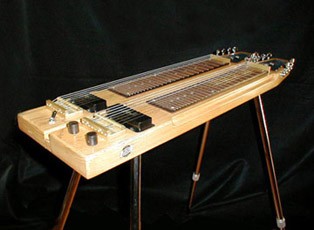
From the Wikipedia entries for Steel Guitar and Lap Steel Guitar:
Steel guitar refers to a method of playing on a guitar held horizontally, with the strings uppermost and the bass strings towards the player, and using a type of slide called a steel above the fingerboard rather than fretting the strings with the fingers. This may be done with any guitar, but is most common on instruments designed and produced for this style of playing.
The technique was invented and popularized in Hawaii, thus the lap steel guitar is sometimes known as the Hawaiian guitar, particularly in documents from the early 1900s, and today any steel guitar is frequently called a Hawaiian steel guitar. However in Hawaiian music, Hawaiian guitar means slack string guitar, played in the conventional or Spanish position.
Steel guitar technique also developed from bottleneck guitar, which is a similar technique to steel guitar but with the guitar held in the conventional position, and using a different form of slide to accommodate this playing position.
It is widely reported that The lap steel guitar was invented by a man named Joseph Kekuku in 1885. It is said, at the age of 7, Joseph was walking along a railroad track and picked up a metal bolt, slid the metal along the strings of his guitar and was intrigued by the sound. From there he taught himself to play using this method with the back of a knife blade. Still various other people have been credited with the innovation. The instrument was hugely popular – a major fad – in the United States during the 1920s and 1930s. It was electrified in the early Thirties by Bob Dunn, a musician in Houston,Texas (who played in the Western swing band Milton Brown and His Musical Brownies; Dunn had his own self-named music store in the Houston area.) This made the so-called “Hawaiian” guitar the first electric instrument (just a few years before Les Paul and Charlie Christian modified their instruments).
The lap steel, dobro and pedal steel guitar are associated most closely with Hawaiian music, country music and bluegrass, though some players have used them in rock music, jazz, blues, and other musical genres. The round neck, metal-bodied resonator guitar, on the other hand, is used almost exclusively by blues, rock, or blues-rock musicians.
From the film The Little Giant (1933), featuring Edward G. Robinson.
The legendary Hawaiian guitar master Sol Hoopii provides the background steel guitar playing in these two Pre-Code scenes.
“Yodeling Boogie” (1950) by Wesley Tuttle.
The equally legendary Speedy West almost steals the show at 2:10. Notice the eye candy sitting and clapping along by Speedy’s feet.
[audio:Daniel_Lanois___JJ_Leaves_LA.mp3]
“JJ Leaves LA” (2003) by Daniel Lanois.
A complete change of pace from the breakdowns shown above, this sublime atmospheric number from Lanois’ thoroughly brilliant album Shine seems to point a futuristic direction for the lap steel guitar. Bruce Kaphan’s Slider album from 2000 took a similar approach to pedal steel playing, in the name of New Age Music (it is on the Hearts of Space record label).
An homage:
[audio:Ry_Cooder___Steel_Guitar_Heaven.mp3]
“Steel Guitar Heaven” (2008) by Ry Cooder
Tags: music
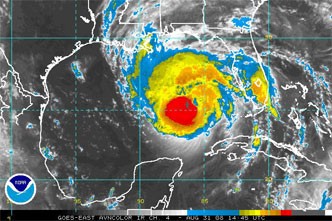
(photo: AP)
MSNBC’s weather guy, Gary Archibald, today used the New Word, “encirculating,” to describe the movement of Hurricane Gustav as it moves toward the American Gulf Coast.
Approximate usage: “You can see how the outer bands of Hurricane Gustav are encirculating the very wide core of this potentially disastrous storm.”
Tags: language
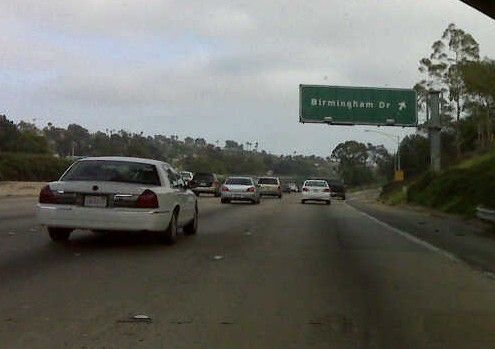
Southbound on Interstate 5, on the way to Reunion Event #1 in San Diego.
Taken with the Blackberry, 1 August 2008.
Tags: signs
August 29th, 2008 · 1 Comment
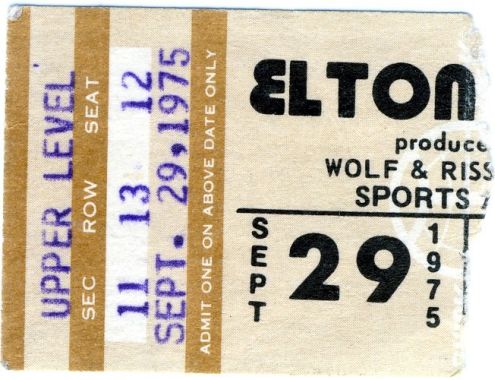
Another treasure from the piles…can you believe I still have this!? This concert was at the San Diego Sports Arena. I wasn’t of driving age yet, so my mother drove me to the show. Remember that scene from Almost Famous where the kid’s mother drops him off – at the San Diego Sports Arena! – and shouts after him, “Don’t do drugs!” There was that tone about this night. Afterward, my Mom said it was cheaper to enjoy the concert from the parking lot, because she could hear everything from inside, as she sat in the car and waited for us in the parking lot. Side note: it is no fluke that the Sports Arena is featured in that scene from Almost Famous. Cameron Crowe, who wrote and directed that film, went to my high school in San Diego (two years ahead of me, I think) and we shared several of the same musical experiences in that city.
My memory is that it was a great show. We were seated in the upper deck, but just forward of the front of the stage, up on the stage left side. From that vantage point, we could see everything, and Elton faced us when he played the piano. Ray Cooper was great fun to watch, as well, gyrating and banging on every percussive object within reach. There were gray styrofoam boulders strewn around the stage, and at strategic moments (or whenever the urge would take hold of him), EJ would pick one up and hurl it into the crowd. At one moment, he grabbed onto a cable hanging from the rafters and swung clumsily out over the first few rows of the audience seated on the floor. This was during his crazy antics phase, the big glasses stage, and about two weeks before the U.S. release of Rock of the Westies (hence, the boulders).
I can’t remember what was played, but I found a set list from an October 14, 1975 show in Portland, Oregon at this site. Here it is:
Your Song
I Need You To Turn To
Border Song
Take Me To The Pilot
Dan Dare (Pilot Of The Future)
Country Comfort
Levon
Rocket Man (I Think Its Going To Be A Long Long Time)
Hercules
Have Mercy On The Criminal
Empty Sky
Funeral For A Friend / Love Lies Bleeding
Goodbye Yellow Brick Road
Bennie And The Jets
Harmony
Dixie Lily
Captain Fantastic And The Brown Dirt Cowboy
Bitter Fingers
Someone Saved My Life Tonight
The Bitch Is Back
Don’t Let The Sun Go Down On Me
(Gotta Get A) Meal Ticket
Lucy In The Sky With Diamonds
I Saw Her Standing There
Island Girl
We All Fall In Love Sometimes / Curtains
Pinball Wizard
I imagine that the San Diego set list was similar to this Portland set list. It was after this tour that the quality of EJ’s output started to become spotty. Nonetheless, there couldn’t have been a better discography from which to pull a long set list like this one, so we were surely fortunate to have seen him at this time.
The following video is from the Dodger Stadium concert, barely a month after the one in San Diego:
This series of shows signaled a peak, of sorts. It was sometime during the week of this October 1975 concert, dubbed “Elton John Week” by the city of Los Angeles, that he endured a drug overdose.
This year, Elton John celebrated his 60th birthday with a spectacular concert buoyed by a set list that borrowed heavily from his early songbook. Here is the 2008 version of “High Flying Bird,” originally from the 1973 album, Don’t Shoot Me, I’m Only the Piano Player:
Ah, for the good old days.
Tags: music
Tags: music


