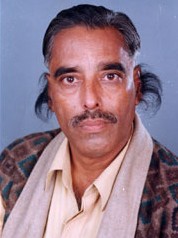
This handsome gentleman has the distinction of a mention in the Guiness Book of World Records as the source of the world’s “longest ear hair.” He has held the title since May of 2003. Dude, it is nearly 10 inches long. Eeeeeew!
Here is the link to the Guiness Book website. And here is a link to a series of pictures of Mr. Radhakant Bajpai grooming his aural locks.
Slow news day.
Tags: Uncategorized

An 8-track CD from a recent Josh Ritter live performance will be released on April 19 ’08. The concert took place on October 9, 2007, at the 9:30 Club in Washington, DC. The track listing, consisting primarily of songs from The Historical Conquests of Josh Ritter, is as follows:
1. Mind’s Eye
2. To The Dogs or Whoever
3. Rumors
4. The Temptation of Adam
5. Right Moves
6. Real Long Distance
7. Lawrence, KS
8. Next to the Last Romantic
Though at this writing it is not listed there, I assume it will be available on release day at Josh’s website, if not before.
In other Josh news, Mr. Ritter is scheduled to play in Birmingham on May 4th at The Bottletree Cafe, potentially limiting the number of people who will see the show. Bottletree has about one-third the crowd capacity of the Workplay Theatre, where Josh has played to a full house the last few times he has come through B’ham.
Tags: music
[audio:Jimmie_Riddle___Eephing.mp3]
from I’m On My Journey Home: Vocal Styles and Resources in Folk Music.
The identity of the Eepher is unknown [update: see below].
There is only one person I know who might be able to do this well, and his name is Bobby Horton.
Tags: history · music
from Woodstock: The Oral History, by Joel Makower:
Abbie Hoffman: It looked like five thousand people on bad acid trips coming down the road doing the St. Vitus’ Day dance, half-naked, stoned, and they all came in to the trip tents. They got in the farm. And Wavy [festival host and M.C. Wavy Gravy], he was quick and good. He just said, “Jump on them all, everybody.” They have a term for it – I don’t know, some kind of happiness hill. And everyone was just in these human piles and the ones that were freaking out and the ones that were giggling were just like mixed up like a whole can of worms. And I’ll tell you, it worked. I tell you it was damn good and it worked and no one got hurt and everyone got out of it in one piece. But just seeing that mound of hundreds of people piling in and him being so good and setting a kind of tone that was jovial and “We’re having a good time” was exactly right because the wrong vibes, as we used to call it, could have sent that thing into a violent riot like that. Woodstock could have turned into the tragedy that Rockefeller had envisioned so easily. I mean, it could have been five hundred to a thousand dead just from panicking, from bad information or, you know, “Someone’s got a knife, run!” And you know, you could have seen thirty thousand people start to stampede up a hill, I mean very bad. Especially in the nighttime.
Tags: history · music

Feeling stressed and frustrated? Need someone to take your aggression out on? And somewhere to keep that pesky pen you keep losing under the edge of your computer keyboard? Well, Dead Fred is the man for you!
Alleviate all that pent up aggression by violently and repeatedly stabbing Fred through the heart…and as if by magic there it is, just where you left it, your pen right at your fingertips – and your stress and frustration, vanished!
Thanks, fellas. I use it every day.
Get yer voodoo doll pen holders here!
Tags: Uncategorized
One of the first things I did upon purchasing this little bungalow of mine was to peel the wallpaper from the bathroom walls. Or, rather, one of the first things I did was try to peel the wallpaper from the bathroom walls.
I didn’t really dig the brown flowers on the tan background. Too dreary and too brown. It was, after all, on the bathroom walls, and I just didn’t need any more emphasis on that color. So, I started ripping it down.
Underneath the brown flowers was an aqua and bone-colored pinstripe pattern. I really don’t like blue as a household color. I had painted the exterior of my home a steely gray/blue shortly after I moved in, and regretted it daily until three years ago when I covered it over with another color scheme. Now it is a fantasia of suede and mahogany hues, and my neighbors like it almost as much as I do. But blue pinstripes in the bathroom? No, thanks. So I started peeling that, too.
None of this was going nearly as easily as I had hoped. I would occasionally pull off an odd-shaped strip nearly as long as my forearm, but otherwise I was removing a nibble at a time, my progress becoming as patchy as the walls’ new appearance. Remnants of the brown flowers and the blue stripes remained on the wall when I got to the next layer – a paper skin that had inhumanely been covered with bright yellow paint. Yellow like those marshmallow Peeps that were always the last thing left in my Easter basket. It was a very unappetizing sight.
And there I stopped, about ten years ago.
This week, with considerably more time on my hands than I have had in the past several years, I decided to attempt a bathroom renovation. The bathtub surround is currently lying in pieces by the curb, and I have dozens of pictures of bathroom hardware spread across the dining room table. But, first, before anything else, I knew I had to bring down that wallpaper.
Previously, I had tried scoring the walls with a Papertiger, and spraying them with DIF, but neither approach yielded results. I jumped online and Googled “wallpaper removal.” The first several entries were paid advertisements for DIF, so I skipped them. Then I hit a series of entries that advocated the “green” use of vinegar. I hate the smell, so I continued. One witty website advised using fabric softener:
Step 3:
Mix equal parts of fabric softener and warm to hot water. Pour it into a clean spray bottle. Use one that’s sturdy as it will take a lot of hard use during your project. Some folks like vinegar and warm water in equal parts but the fabric softener seems to often do better.
I had recently purchased three bottles of Nice ‘n Fluffy at a fat discount, so I decided to try it. I opted for the wet and sloppy approach, and prepared the mixture in a painter’s tray. Then, using a roller on an extendable pole, I got a healthy dose of the now Hot ‘n Nice ‘n Fluffy on the roller and began spreading it on the wall. My stanky bathroom smelled just like mountain rain!!
After two messy and drippy applications, do you know what happened? I reached up, ran the palm of my hand over a section of aqua pinstripes and they just slid away. Right into a goopy pile on the tile floor. It was a miracle! There was still some glue and backing paper left on the wall, but with the aid of a 3-inch scraping tool and another dose or two from the paint roller, it eased right off. I was left with a hideous mess on the floor, but also a beautiful bare plaster wall upon which I could now inflict my non-blue, non-brown, non-wallpaper bathroom artistry.
I’ll probably paint it white.
Tags: house
I spent a good portion of my childhood on a bicycle. The first bike I had was a purple Stingray with a banana seat. It looked like this, only purple:

It was a fun bike, and could go just about anywhere that I could pedal. When I graduated to a new bike, my clever Dad, who always had a few tinkering projects going, decided to put a chopper extension on the front tire of the Stingray. I could never get the hang of balancing it, so it rarely had a rider again. It did look mighty cool, though.
Coastal Southern California is a great place to ride a bicycle…
Whoa!! Remember that Psychic iPod post I wrote a few days ago? Just as I am writing this, my computer’s iTunes began playing this song. Check out the first line:
[audio:Melanie___Brand_New_Key.mp3]
Anyway, when we lived closer to the beach it was easier to ride the bike everywhere. When I was 10 years old, we moved inland a few miles. Our house was very nearly the highest point in the city, and we had a breathtaking view from the front porch all the way down to the water. On really clear days, we could even see the outline of Catalina Island. The only problem with that new location, though, was that there were hills, and pumping up those hills – one of which was a block and a half long at a 45 degree angle – could really burn up your legs!
I had gotten into the habit of riding my bike to school most days, and the new house location just made it more challenging. I was probably in pretty good shape there for awhile. One day, on my way in to school, I was coasting down the mountain on my 10-speed and a harried woman came barreling around the corner, rushing to get her kid to school and herself to work on time. She just appeared there in front of me, coming directly at me in my lane. There was no time to react, other than to slam on the brakes and try to absorb the collision with my front tire. And that is what happened. When we had both come to a complete stop, I was still standing astride my bike in the middle of the road. The front tire was crumpled like an accordion at rest, and the only injury I sustained was a skinned thumb. A minute or two later, my older sisters drove by on the way to their high school, and gave me and my poor bike a lift.
I was pretty goddam lucky that day.
Biking became a lot more fun when I moved to Cambridge to attend college. It was all pretty flat terrain around the Charles River basin, and my studies took me back and forth between Mass. General Hospital and the Harvard Square area quite a bit. As a result, I became very familiar with the bike paths along the Charles, and the unique etiquette of passing runners, walkers and other bikers, and allowing other bikers to pass me. I never needed a car when I lived in Massachusetts – my bike and the T got me everywhere I needed to go. On weekends, I’d bike out to Walden Pond or north of the city, once riding over 40 miles in the rain to hang out with friends in Rockport (who probably got there in a car).
Moving to Alabama effected a sharp decline in my bicycling activity, as I now owned a car. It is also pretty hilly here. Occasionally during the first couple of years here, a fellow graduate student and I would rack our bikes on the car and drive to Oak Mountain State Park, where we would ride the roads. They have a couple of lakes there, and a waterfall, and lots of trees, so there were nice places to stop and rest between completely wearing ourselves out. One day, we were really kicking up some speed on the main road through the park and, coming around a corner, I passed a car around its left side as if it was standing still. Well, it wasn’t standing still. And it was a police car. The officer turned on his siren and caught up with me, threatening to write me a ticket for speeding. There’s a first time for everything, I thought. We had a good laugh about that one. After the policeman drove away.
After leaving graduate school and joining the work force, I rarely rode. Two years ago (a time jump of over 15 years, I am sorry to say), I bought a new bike. It is just now getting some use, and I took it with me to South Carolina last month. The area around Charleston is flatter than either Boston or San Diego County, and the roadsides around my mother’s home are woven with a magnificent network of paved bike trails. I got in a few long rides while visiting, but watched my speed because, well, you never know who might be right around the corner. Returning to Birmingham, I resolved to do more riding, no matter how much it might hurt.
Once my legs get acclimated to riding the hills here, my first goal will be to keep pace with a police car.
Tags: family · Uncategorized
The lean days, blue skies with never a cloud, a sea of blue day after day, the sun floating through it. The days of plenty – plenty of worries, plenty of oranges. Eat them in bed, eat them for lunch, push them down for dinner. Oranges, five cents a dozen. Sunshine in the sky, sun juice in my stomach. Down at the Japanese market he saw me coming, that bullet-faced smiling Japanese, and he reached for a paper sack. A generous man, he gave me fifteen, sometimes twenty for a nickel.
“You like banana?” Sure, so he gave me a couple of bananas. A pleasant innovation, orange juice and bananas. “You like apple?” Sure, so he gave me some apples. Here was something new: oranges and apples. “You like peaches?” Indeed, and I carried the brown sack back to my room. An interesting innovation, peaches and oranges. My teeth tore them to pulp, the juices skewering and whimpering at the bottom of my stomach. It was so sad down there in my stomach. There was much weeping, and little gloomy clouds of gas pinched my heart.
My plight drove me to the typewriter. I sat before it, overwhelmed with grief for Arturo Bandini. Sometimes an idea floated harmlessly through the room. It was like a small white bird. It meant no ill-will. It only wanted to help me, dear little bird. But I would strike at it, hammer it out across the keyboard, and it would die on my hands.
What could be the matter with me? When I was a boy I prayed to St. Teresa for a new fountain pen. My prayer was answered. Anyway, I did get a new fountain pen. Now I prayed to St. Teresa again. Please, sweet and lovely saint, gimme an idea. But she has deserted me, all the gods have deserted me, and like Huysmans I stand alone, my fists clenched, tears in my eyes. If someone only loved me, even a bug, even a mouse, but that too belonged to the past; even Pedro had forsaken me now that the best I could offer him was orange peel.
– from Ask the Dust (1939)
John Fante (1909-1983) wrote pulp-noir fiction that was largely autobiographical. The narrator of Ask the Dust, Arturo Bandini, is struggling at a career as a writer in depression-era Los Angeles.
Tags: fiction · ideas · language
Recently, I re-read Ernest Hemingway’s The Sun Also Rises. Other than having read The Old Man and the Sea in school, it is the only Hemingway I have ever read. That surprises me, thinking on it now, as I really loved the experience of reading Sun. I retained the thrill of the language of that book in my mind. That normally would have motivated me to track down and read other Hemingway books, but it never happened. I can’t even recall accurately when I had previously read this book. I am guessing that it was in high school. I don’t know for sure.
One of the impressions that the book left me with – the first time – was how quixotically romantic it would be to spend lazy afternoons in a Spanish outdoor cafe sipping port and reading the racing columns. Even though I am not a fan of port. Port and sherry were a staple at early evening gatherings in college and I tried it several times, but our relationship never developed beyond a few cordial sips. And racing and other forms of gambling are alien to me. And I’ve never been to Spain. Just as in the song.
This time around, I fell completely in love with Hemingway’s use of language. I posted a vignette from the novel here, and it is representative of the rest of the book. I zipped through the book this time much more quickly than when I was in high school and, while decelerating after the read, felt a hunger for more. So I picked up A Moveable Feast.
Even though I have made tentative mental plans to travel to Europe, I have never made the trip. I would love to see Vienna, the rolling stone walls of Cornwall and Yorkshire, the rocky landscape and walled villages of Andalucia, the Hebrides. My impressions of these places are all informed by books and film: The Third Man, the James Herriot books, Don Quixote, Michael Powell’s I Know Where I’m Going. Now I can add Paris to the list.
However, I doubt that the Paris of today would resemble the Paris of the 1920s that Hemingway writes about in A Moveable Feast. Hemingway spends his days wandering the districts of the city, visiting friends, chatting up the local merchants and artists, going to the races, drinking, and spending just enough time at his writing “job” to provide for the most basic living amenities. Today, he wouldn’t be able to live like that, but in the ’20s it could be managed. A recent article in the Birmingham News quoted the successful author [read: sells a lot of books] Walter Mosely as saying that his “writer’s life” consists of three hours a day of actual writing. I suppose the rest of the day is spent gathering ideas from everyday activities. If so, Hemingway seems to have done his job well.
One of my favorite chapters in the book, titled “Hunger Was Good Discipline,” details a period when Hemingway could barely afford the minimum requirement of food and drink necessary. He describes his afternoons walking, mapping out new routes through Paris that would take him past the fewest cafes and food shops, and reflecting on how this hunger fueled his art.
You got very hungry when you did not eat enough in Paris because all the bakery shops had such good things in the windows and people ate outside at tables on the sidewalk so that you saw and smelled the food. When you had given up journalism and were writing nothing that anyone in America would buy, explaining at home that you were lunching out with someone, the best place to go was the Luxembourg gardens where you saw and smelled nothing to eat all the way from the Place de l’Observatoire to the rue de Vaugirard. There you could always go into the Luxembourg museum and all the paintings were sharpened and clearer and more beautiful if you were belly-empty, hollow-hungry. I learned to understand Cezanne much better and to see truly how he made landscapes when I was hungry. I used to wonder if he were hungry too when he painted; but I thought possibly it was only that he had forgotten to eat. It was one of those unsound but illumintaing thoughts you have when you have been sleepless or hungry. Later I thought Cezanne was probably hungry in a different way.
He ends up selling a story unexpectedly, and takes the money to buy himself a meal of beer, potato salad and sausages, which he describes in sensual detail.
Yesterday, I wrote a post about a Graham Parker song, and found myself prattling on in the most self-indulgent way about a guy who had introduced me to Parker’s music. I read that passage over several times and just hated it. I am grimacing right now thinking about it, and only inflict it upon you now as an example. It went something like this:
Previously, I had seen him only on the outskirts of my experience, hanging around the communal grill, playing foosball, wearing a black mechanic’s jacket zipped up to his chin, smoking cigarettes, reading a paperback Penguin Classics volume in a corner of the courtyard. When I visited their suite, he usually stayed in his room with the door closed, playing music sometimes but mostly quiet. During one of my visits, he passed through the room, where we were fruitlessly attempting to dissect meaning from the Scottish band Big Country’s album The Crossing, and slowed only long enough to mutter his approval of the music.
This was becoming more a character study and less a piece about a talented songwriter. With A Moveable Feast fresh in my mind, I thought, how would Hemingway approach this dilemma? I closed my eyes and sliced away:
Prior to this exchange, the only musical idea he had shared was his admiration for Big Country’s The Crossing. Now, however, I viewed him as a person of substance.
I could always write a character study later. The lessons I have been learning from reading more Hemingway – eloquence through brevity, for example – served me well in this instance, and maintained focus on the subject of the post.
Tags: books
My first exposure to Graham Parker was the result of a reaction to my enthusiastic cheerleading for Elvis Costello. While visiting the room of a friend in college, somehow the topic of conversation made its way to music and EC worked his way into my contribution. One of my friend’s suitemates – a “townie” who I previously had very little occasion to interact with – gave the following RIYL comment: If you like Elvis’ lyrics that much, you really ought to check out this record…I think everything Elvis Costello does with wordplay he learned from Graham Parker. And he pulled a vinyl copy of Squeezing Out Sparks from the shelf, put it on the turntable, and cued up “You Can’t Be Too Strong.” I was dumbstruck by the song (only discovering much later that its beauty belied the fact that one of its topics was abortion). Prior to this exchange, the only musical idea he had shared was his admiration for Big Country’s The Crossing. Now, however, I viewed him as a person of substance.
As a result, I have kept a keen interest in Parker’s prolific recording career, and try to acquire every album he makes. My favorites among them have been Another Grey Area, Human Soul, The Mona Lisa’s Sister and Burning Questions. But he seems to remain mostly unnoticed and only quietly heralded as an artist. Unlike Elvis Costello, who can sell out a few thousand seats in Birmingham today, the last time I saw Parker appear here – at the annual outdoor music festival – he drew a couple hundred people, at best, and he cut his segment to 30 minutes so that the headliners could keep their sets to their scheduled start times. Shameful. But, backstage, he was cordial, talkative and seemingly accustomed by habit to the ongoing public neglect. And despite the illusive commercial success, Parker keeps on touring and recording, always keeping the bar of quality high.
It was a pleasant jolt when my Random Song Machine began to play “Platinum Blonde” yesterday. I hadn’t listened to Burning Questions in a long time, so I cued it up and enjoyed the album from start to finish. “Platinum Blonde” is a good representation of what the record has to offer. Not too many songs combine literate insights into disgust, disillusionment and artificiality in one place. And you most definitely won’t hear content like this on the radio today.
So, here’s to you, Graham Parker! Please keep doing your own thing. Some of us out here are still listening.
[audio:Graham_Parker___Platinum_Blonde.mp3]
from the album Burning Questions (1992)
Stuff comes down from the golden triangle
On ferries from Denmark to Helsingborg
The band strikes up but they’re out of time
On synthesiser and washboard
Wooden tulips grow by the roadside
Made in a factory in Jonjoping
Fake glass baubles hang in the station
Just like the passenger’s imitation
It’s then it hits you she was just the dregs
All you wanna do now is break her legs
Kick that brunette into a pond
Replace her with a…
Platinum blonde
Platinum blonde
Platinum blonde
Platinum blonde
There’s a secret world that you cannot enter
It’s in the center of the darkest night
She’s waiting there with a set of works
And a Swedish passport and something white
She walks past but you can’t form a whistle
Even her lips look artificial
You wanna follow her but you can’t swallow her act
It seems so superficial
Now you’ve shed the old one like a worn out shoe
It was all your fault but you blame her too
You know it’s phony but at least it’s new
And it comes from a bottle like…
Platinum blonde
Platinum blonde
Platinum blonde
Platinum blonde
And in your heart there’s a new addiction
Another friction that you can’t resolve
She seemed alive but she is just a cipher
An imaginary postcard that just dissolved
Endless sunsets glow in the distance
Painted by Picasso’s assistants
Perfect people travel in Volvos
Into the sunsets into the distance
You’re just a passenger she’s not a ticket
A foreign stamp you’ve got to lick it
Put it in the mail box
Put it in the fail box
You never seem to learn from the school of hard knocks
Then she walks past and laughs at the pond
You can’t break a heart that doesn’t respond, like…
Platinum blonde
Platinum blonde
Platinum blonde
Platinum blonde
Tags: music · Random Song Machine


