Of course, there is always something that can go wrong, and my driver’s license expired on 9.1, so I was flagged as “SSSS” or “special screening.” It basically meant nothing more than being sent through a separate line and being paid extra special attention. That was OK by me. The handlers were all very nice and I honestly can’t see what all of the fuss is about – people complaining that they’re constantly being delayed due to security at airports, and what an inconvenience it is. Small price to pay for a sense – nothing more – of security. Maybe they ought to leave for the airport 30 minutes earlier next time.
Anyway, I’m on my way to Boston now. Somewhat mixed feelings after the phone call from Mom last night [illness alert]. Can’t say that there is anything I could do if I didn’t go on this trip, but I’ve got a feeling of guilt nonetheless.
I haven’t been on an airplane since 2000 [yep, seven years without setting foot on an airplane], when I flew a few times to California when Dad was sick. It’s a very different procedure now. Seems that the airlines have left most of the work to computers, as I got my parking deck ticket from an automated machine, and checked-in on a touch-screen computer, received my boarding passes from a computer. All that the person at the counter did was wrap a sticker/tag on the handle of my suitcase. It was very easy, but certainly not personal.
There were seven separate animals being checked in for my flight: six dogs and a porcupine. I asked the freight guy who was standing there about all the animals – he said it was the first porcupine that he’d ever shipped!! What a claim. [To see a real flying porcupine circa WW2, check out this video.]
Seemingly out of nowhere, I received an invitation from my friend Elisa, via Facebook, to take part in the Critical Mass event in Birmingham last Friday. I say “out of nowhere” with only partial accuracy, as Elisa knows that I have started riding my bicycle again, and she is a cycling enthusiast, as well. The surprising aspect was that I had never heard of Critical Mass before, even though it has been around for years.
Critical Mass events occur on the last Friday of each month. They were started as a form of awareness-raising for the co-existence of bicyclists with automobiles on roadways. The first event was in 1992 in San Francisco. Since then, they have come to be considered a form of political protest, a social movement, and are unique in that the typical Critical Mass gathering is rhizomal, rather than hierarchical (I won’t take credit for that imaginative use of the word “rhizomal,” which I cribbed from a very detailed description of Critical Mass on Wikipedia that I recommend you read). If you spend much time in the garden, you know that I am likening the group structure and format of this organization to a self-propagating plant, and it fits.
Since taking up biking again this year, I have been trying my best to discover “friendly” routes around the city. My motivation has been three-fold: I could use the exercise, gasoline costs have gotten worse than ridiculous, and my carbon footprint has gotten much larger than my shoes can contain (so to speak). Birmingham is not easy for bicycles, however. There is one bike lane in the middle of the city, and it is essentially an extra lane on 7th Avenue South that connects several business areas without approaching any residential areas. I imagine that it’s useful to couriers, but that’s it. The two best routes that I have found between my home and downtown take me either down a very heavily travelled road filled with speeding and honking cars, or along a frontage road that parallels the railroad tracks, and is riddled with ruts that threaten to grasp my front tire and toss me over the handlebars. Elisa confirmed my opinion of the sorry state of road cycling when she described in excited detail her reactions to the reckless behavior of car drivers in this city, which consist of high-volume vocal protests and energetic extensions of her middle digit.
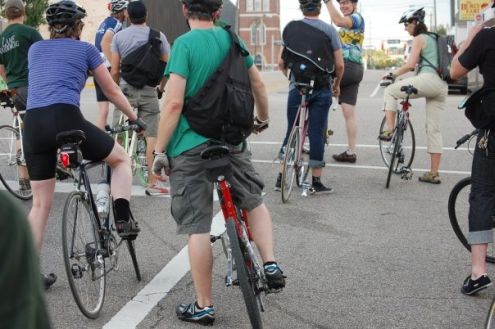
The Critical Mass ride on Friday attracted the largest group yet in Birmingham, according to one of the regulars, who told me that the group was only begun here this past February. Our group was 18 cyclists strong. The bikes ranged from sleek touring cycles to beach cruisers. The attire ranged from skin-tight logo-laden apparel to baggy khaki shorts (me). Some riders had helmets, some wore baseball caps. Men and women, ranging in age from around 20 years of age into their 50s. Compared to Critical Mass groups in some larger cities, we were tiny, but there was an excitement among the people there that seemed to indicate that the idea was finally taking hold. For instance, we haven’t gathered enough riders to pull off a “cyclone” yet, but that day may be here before long.
Birmingham Critical Mass event: 27 June 2008 (photo: Elisa M)
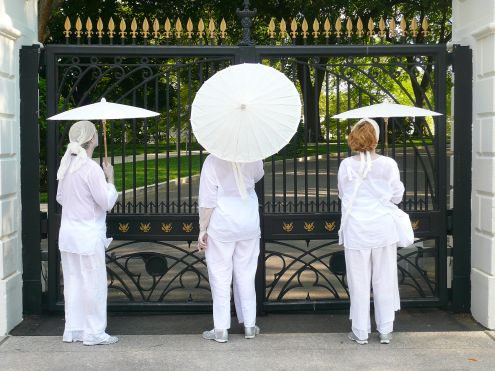
The political aspect of Critical Mass was not fully clear to me until I read that Wikipedia entry this morning. Reading about it encouraged me that I might actually have found a way to be an “applied activist”; that is, to be involved in a movement or for a cause that could directly impact the way that I, and others, live. I am in hushed and reverent awe of people I know who regularly step out of their daily routine to make their voices heard in selfless ways. In particular, my cousin Margy, who has always been one to translate her political opinions into action. Recently, she travelled from the West Coast to Washington, DC, and performed Memorial Day Butoh dance tableaux in front of the White House as a protest against the current administration’s policies. [For more informaion about that group of citizens – the Ground Zero Players – and their activities, click here.] That is the kind of conviction that most of the rest of us rarely have an opportunity, or the inclination, to express.
Not barbarians, but Butoh-ians, at the White House gate.
I am of the opinion that the priorities of the city of Birmingham ought to be focused on maintaining and improving its current infrastructure to keep the quality of life of its citizens as high as possible. That does not mean building a flashy new equestrian center on the western outskirts of town, or a domed stadium on the eastern edge of the city. The city we live in needs to be user-friendly. Part of that very simple concept includes providing ease of access for citizens who desire to be ecologically-conscious as well as for those who are physically-impaired, to encourage the use of self-propelled transportation as well as establishing a more widespread and accessible mass transportation system.
These are simple and easy ideas that everyone can agree on.
Will you join our critical mass next month? We’ll meet at 6:00 p.m. where 20th Street South meets Linn Park, and will proceed on our cycles – in rhizome-like fashion – from there.
Wild Sweet Orange, a band hailing from right here in Birmingham, Alabama, made their national television debut on Late Night with David Letterman last night. Their new album will be unleashed on the public on Tuesday, July 29th. The band played their song “Ten Dead Dogs.” Here’s the video clip:
Have you heard, or seen, the current television commercial for Aviva Financial Services?
Aviva has licensed the song “Aquarius/Let the Sunshine In,” originally in the musical play Hair, and later recorded by The 5th Dimension as a chart-topping hit.
The arrangement of the song that is used in the Aviva commercial is instrumental until the end of the spot, when a brief part of its title-bearing chorus is sung.
The chord progression sounds remarkably similar to The Eagles’ song “Hotel California.” I found myself humming “Hotel California” this evening while within earshot of the TV, then was startled when I heard the “Aquarius” chorus join me at the end of the ad.
Can I demonstrate this co-incidence by showing you the commercial via YouTube? Yes, I can:
Audio clips of the two songs, for your examination:
[audio:5th_Dimension___Aquarius_Let_the_Sunshine_In_(excerpt).mp3]
“Aquarius/Let the Sunshine In” by The 5th Dimension [edited to begin at 2:18]
[audio:Eagles___Hotel_California.mp3]
“Hotel California” by The Eagles
The late author and actor Spalding Gray’s 1991 monologue “Terrors of Pleasure” is a hilarious and horrifying document of his obsession with home ownership. No one involved in the uncomfortable process of selling Gray the “little house that cried” is spared skewering, nor are his Catskills neighbors or the crusty New England workmen who attempt (or avoid) repairing the cabin’s defects.
Spalding Gray recorded this monologue in 1991. A short film – with fewer asides – was also made from this material, but is very difficult to find. Below is a clip from the audio recording.
At this point in the monologue, Gray has met with realtor Jamie d’Angelo at least once to investigate purchasing a decrepit cabin in the mountains, thinking that it would make an ideal, rustic setting, perfect for inspiring his writing career. Upon closer inspection, the house is rife with serious problems, including – but not limited to – a furnace in the attic, a shifting foundation, and a porch that is travelling away from the building. Gray has expressed his intentions to buy the property, contingent on d’Angelo arranging repairs to the home. D’Angelo is unaware that Gray has spoken to some of the same people about doing the work.
[audio:Spalding_Gray___Terrors_of_Pleasure_(excerpt).mp3] excerpt from “Terrors of Pleasure” (1991) by Spalding Gray
Unfamiliar with Spalding Gray’s work? Here’s a short clip (just under six minutes) from the Jonathan Demme film of his monologue, Swimming to Cambodia, in which he recounts his experiences while filming The Killing Fields:
In 1999, Kenny G released a “mash-up” of “What a Wonderful World,” melding his soprano saxophone acrobatics with the classic recording of the song by Louis Armstrong. The resultant album and single sold very well, following in the steps of the Nat/Natalie Cole re-construction of “Unforgettable” (which, not by mere coincidence, was produced by the same man: David Foster).
On June 5th, 2000, on the message board of his website, jazz guitarist Pat Metheny posted a lengthy treatise about Kenny G’s talents, with a specific critique about the desecration of Satchmo’s legacy. This missive has been reprinted many places since its first appearance on the ‘net, but I felt it merited another look. The full text follows:
Question:
Pat, could you tell us your opinion about Kenny G – it appears you were quoted as being less than enthusiastic about him and his music. I would say that most of the serious music listeners in the world would not find your opinion surprising or unlikely – but you were vocal about it for the first time. You are generally supportive of other musicians it seems.
Pat’s Answer:
kenny g is not a musician i really had much of an opinion about at all until recently. there was not much about the way he played that interested me one way or the other either live or on records. i first heard him a number of years ago playing as a sideman with jeff lorber when they opened a concert for my band. my impression was that he was someone who had spent a fair amount of time listening to the more pop oriented sax players of that time, like grover washington or david sanborn, but was not really an advanced player, even in that style. he had major rhythmic problems and his harmonic and melodic vocabulary was extremely limited, mostly to pentatonic based and blues- lick derived patterns, and he basically exhibited only a rudimentary understanding of how to function as a professional soloist in an ensemble – lorber was basically playing him off the bandstand in terms of actual music. but he did show a knack for connecting to the basest impulses of the large crowd by deploying his two or three most effective licks (holding long notes and playing fast runs – never mind that there were lots of harmonic clams in them) at the keys moments to elicit a powerful crowd reaction (over and over again) . the other main thing i noticed was that he also, as he does to this day, play horribly out of tune – consistently sharp.
of course, i am aware of what he has played since, the success it has had, and the controversy that has surrounded him among musicians and serious listeners. this controversy seems to be largely fueled by the fact that he sells an enormous amount of records while not being anywhere near a really great player in relation to the standards that have been set on his instrument over the past sixty or seventy years.
and honestly, there is no small amount of envy involved from musicians who see one of their fellow players doing so well financially, especially when so many of them who are far superior as improvisors and musicians in general have trouble just making a living. there must be hundreds, if not thousands of sax players around the world who are simply better improvising musicians than kenny g on his chosen instruments. it would really surprise me if even he disagreed with that statement. [Read more →]
My post of January 21st, 2008 was admitedly weak, consisting of only a YouTube link to a weird and strange video that Ryan Adams created while noodling in the studio. Sadly, someone decided to remove the video from YouTube, so that the video link on the post leads nowhere now.
It kind of bummed me out. But, in retrospect, it serves me right for being lazy and not writing something that day.
However, some form of juvenile retaliation is in order. So I am posting another YouTube link today, this one only interesting for the audio: a voice mail that Adams left for reporter Jim DeRogatis, after reading a scathing review DeRogatis had written about one of Adams’ concerts. An excerpt from DeRogatis’ review:
Absent an historical musical context or a functioning b.s. detector, it is possible to mistake Adams for being as talented and clever as he thinks he is. But then there are plenty of people who can’t tell the difference between plastic flowers and real ones, until they bend over to take a whiff.
You’re gonna love this, as long as the link stays live.
DeRogatis’ “offending” review from the Chicago Sun-Times:
Ryan Adams at the Riviera Theatre December 15, 2003
BY JIM DeROGATIS Pop Music Critic
Ryan Adams would like us to think that it’s incredibly difficult being Ryan Adams — young, talented, clever and outrageously prolific.
In fact, what’s difficult is watching the spectacle of the 29-year-old North Carolina-bred singer and songwriter acting out the whole tired “troubled artist” routine and trying desperately hard to convince us of his genius. [Read more →]
It was a busy day today, and I was on the move for most of it. The constant? My iPod was working overtime, and though I did listen to a couple of albums full through, it was mostly a Shuffle-All-Songs day. The little random song machine did a bang-up job of entertaining me as I went from digging and planting in the back yard, to paying bills, running errands from the post office to the grocery store to the pool, back home to a light dinner and a neighborhood association meeting.
Let me just say, as an aside that has nothing to do with today’s musical soundtrack (but is concerned with other sounds), that when you hear your city councilwoman tell a neighborhood resident at a public meeting that the only way to get the city to repair the sinkhole in the alley behind the resident’s house is to hire a lawyer and sue the city… Well, when you hear that – and I did – you know that things in your city have gotten to a pretty pathetic state. I tend to like and admire Councilwoman Valerie Abbott, but her reaction tonight was tantamount to throwing her hands up in surrender, and it was a little confusing. Come to think of it, she actually did throw up her hands.
Aside over, here are some of the day’s lesser-known musical highlights that you might enjoy as well as I did:
[audio:June_Tabor___Apples_and_Potatoes.mp3]
“Apples and Potatoes” by June Tabor (1994) I honestly couldn’t tell you why I have three June Tabor albums in my collection, but I really do love the earthiness of her voice.
[audio:Khaled___Didi.mp3]
“Didi” by Khaled (1992) This Rai singer from Algeria was on Leno or Letterman one night in, um, well, it says 1992 there, so that must have been when it was. And it was probably Letterman, because watching Leno is against my religion. Khaled practically jumped out of the TV that night, and I was transfixed, even though I hadn’t a clue what he was singing about. Schnarf Niblett would hear this when I would play it at work and say, No wonder those people are killing each other.
[audio:Teddy_Thompson___In_My_Arms.mp3]
“In My Arms” by Teddy Thompson (2008) At first I got angry when I realized that I didn’t know until the release date last Tuesday that Teddy’s new album was being issued. Then I exulted in my newly acquired ordinaryness.
Also, dig the “beach break” beginning at about 1’42.
[audio:Kate_Taylor___Tiahs_Cove.mp3]
“Tiah’s Cove” by Kate Taylor (1978) The album that this song is taken from has been in my ears a fair bit lately. I became familiar with it in that delicate year between high school and college.
[audio:Dionne_Warwick___How_Many_Days_of_Sadness.mp3]
“How Many Days Of Sadness” by Dionne Warwick (1965) (Dedicated to Amy Winehouse and her 70% lung capacity. How many days of sadness, indeed.)
[audio:Fleet_Foxes___White_Winter_Hymnal.mp3]
“White Winter Hymnal” by Fleet Foxes (2008) I’m hopelessly hung up on this band’s two releases, and can’t shake them out of my head…but that’s a good thing, I think. This album got listened through completely today, twice.
[audio:Alison_Krauss___Jubilee.mp3]
“Jubilee” by Alison Krauss (2006) This was featured in the documentary film Paper Clips, which I watched recently.
The event had been planned for days.
The choices made at the Market of Stars were painstaking and calculated.
Once the day’s victuals were in order and cooled,
The entourage proceeded.
They rode a bus past Lechmere
And around Bunker Hill,
Gliding over the river
And behind the hospitals
Until the oval meadow came into view.
The Others had begun to gather on the grass,
Throwing Frisbees,
Dancing to their tribal rhythms,
Sunbathing and looking trim.
They had no appreciation of this art,
Of the purity of the voice
Or the gravity of the opportunity.
They had been seduced by the carnival atmosphere.
The Gourmand slowly led the way
And her assistants followed,
Pulling coolers full of delicacies in her wake,
Pausing at twenty-foot intervals as she stopped to breathe.
This spot, ten rows from the lip of the stage,
This is where we shall establish our base.
One assistant constructed a lounging apparatus.
Another displayed the morning’s newspaper on a side table.
The Gourmand settled into a chair
And shifted forcefully until her shape became its shape.
She sat, firm as a kettle drum,
As the Asian college girls lay on blankets at her feet
Studying organic chemistry.
The Gourmand raised an eyebrow.
Nine hours until show time, said an assistant.
The Gourmand had already begun to sweat.
She removed her jacket.
The sky was cloudless,
The sun was directly overhead.
The Gourmand looked directly at the assistant:
I would like some news.
The assistant opened the Globe to the front page:
Looming hunger strike threatens Dublin…
The Gourmand ripped the paper from his hands
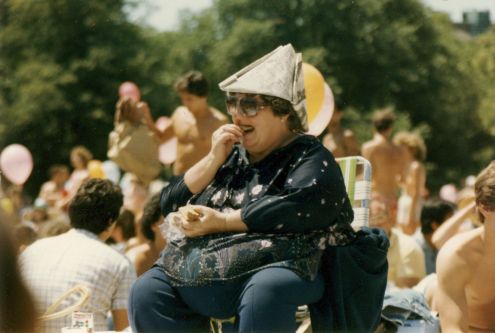
And folded it into the shape of a basket.
The assistant began to open a bag
Containing thick-cut potato chips with Israeli sea salt.
As he reached toward her with the bag,
The Gourmand placed the basket on her head.
First course, please,
The Gourmand suggested,
And the assistants assembled a sandwich
From salami, ham, bologna and pasteurized cheese slices.
The assistant passed the sandwich toward the Gourmand.
Presentation! scolded the Gourmand.
The assistant produced a plastic bag from his pants pocket
And placed the sandwich within it.
The assistant knelt alongside her
And offered the sandwich to the Gourmand with both hands.