from Wikipedia:
The Wilhelm Scream is a near famous stock sound effect first used in 1951 for the film Distant Drums. Actor-singer Sheb Wooley is considered to be the most likely voice actor for the scream, having appeared on a memo as a voice extra for the film.
The Wilhelm Scream has been featured in many films, television programs and video games since. Alongside a certain recording of the cry of the Red-Tailed Hawk, the “Universal Telephone Ring,” the Goofy Holler, the Tarzan Yell, “Castle Thunder,” and the Howie Scream, it is probably one of the best-known cinematic sound clichés.
The Wilhelm’s revival came from Star Wars series sound designer Ben Burtt, who tracked down the original recording (which he found as a studio reel labeled “Man being eaten by alligator”). Although Distant Drums was the first known use of the sound, Burtt named it after “Pvt. Wilhelm,” a minor character who emitted the same scream in the 1953 film The Charge at Feather River.
Although the identity of the individual who recorded the scream (which was actually one of a series of six) remains unknown, researcher and Star Wars sound effects editor Ben Burtt uncovered documentation suggesting the scream might have been recorded by singer Sheb Wooley, who was one of the actors in Distant Drums.
Tags: film
At last!! Last.fm, that is.
Last.fm is a UK-based website that compiles information on music-listening habits, massages that data, and shares the information with an active user base of over 20 million people, making recommendations in a manner similar to Amazon’s system. Wikipedia has a very extensive description of the history and development of the Last.fm website, loaded with much more information than I would ever attempt to lay out here. I have been a member of Last.fm in one form or another for the last two months.
Lately, I’d been looking for a sidebar widget that would allow the readers of my blog to randomly listen to the audio clips featured on various posts throughout Spitballarmy.com. Then I found the Last.fm radio player, which fits right onto this weblog’s sidebar with ease (it’s near the bottom, on the left side of the page).
Last.fm takes stock of all of the tracks that I listen to on my personal computers and both of my iPods. It calculates lists of the most popular songs (that I listen to), the most popular artists (that I listen to), and also prepares a randomly-selected radio playlist drawn from 30,000+ of my files that you can listen to whenever you want. All you need to do is click the PLAY button on the Last.fm sidebar widget, and have SpitballArmy Radio streaming from your computer whenever you wish. There is even an option on the widget that allows you to load the radio into a pop-up window, so that you don’t have to keep your browser page open to the blog.
The first few hours of my listening experience with SpitballArmy Radio has blurred genres very freely. I haven’t heard any classical music yet, but there has been a healthy smattering of jazz (in fact, Miles Davis’ version of “Summertime” just queued up). I hope you’ll check it out, and perhaps it will become a dangerous and addictive habit. You may even be encouraged to start your own radio station and post it on your website….If you do, please let me know by dropping in a comment.
Speaking of comments, please feel free to muse liberally on this topic. I think this is an intriguing facet of the new music industry (you’ll notice links to purchase mp3 files on the widget and pop-up radio). It seems that the programming quality of terrestrial radio has pretty much hit rock bottom, and the most interesting music to be discovered through listening is on the internet (outside of live venues, of course). What could be better than an internet radio station network created by a community of music-loving friends?
Tags: music
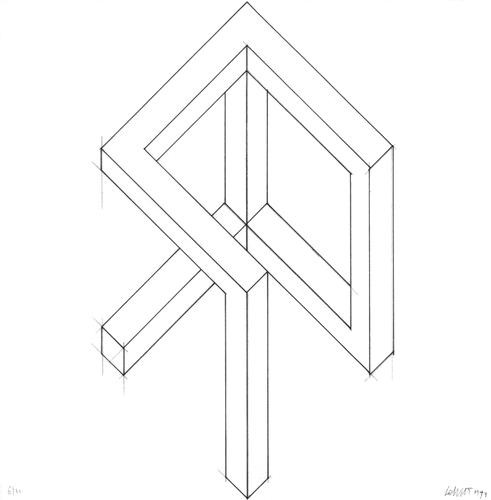
Schematic Drawing for Incomplete Open Cubes (1974)
[ink and pencil on vellum]
11. Ideas do not necessarily proceed in logical order. They may set one off in unexpected directions, but an idea must necessarily be completed in the mind before the next one is formed.
12. For each work of art that becomes physical there are many variations that do not.
13. A work of art may be understood as a conductor from the artist’s mind to the viewer’s. But it may never reach the viewer, or it may never leave the artist’s mind.
14. The words of one artist to another may induce an idea chain, if they share the same concept.
15. Since no form is intrinsically superior to another, the artist may use any form, from an expression of words (written or spoken) to physical reality, equally.
16. If words are used, and they proceed from ideas about art, then they are art and not literature; numbers are not mathematics.
17. All ideas are art if they are concerned with art and fall within the conventions of art.
18. One usually understands the art of the past by applying the convention of the present, thus misunderstanding the art of the past.
19. The conventions of art are altered by works of art.
20. Successful art changes our understanding of the conventions by altering our perceptions.
21. Perception of ideas leads to new ideas.
22. The artist cannot imagine his art, and cannot perceive it until it is complete.
23. The artist may misperceive (understand it differently from the artist) a work of art but still be set off in his own chain of thought by that misconstrual.
24. Perception is subjective.
25. The artist may not necessarily understand his own art. His perception is neither better nor worse than that of others.
26. An artist may perceive the art of others better than his own.
27. The concept of a work of art may involve the matter of the piece or the process in which it is made.
28. Once the idea of the piece is established in the artist’s mind and the final form is decided, the process is carried out blindly. There are many side effects that the artist cannot imagine. These may be used as ideas for new works.
29. The process is mechanical and should not be tampered with. It should run its course.
30. There are many elements involved in a work of art. The most important are the most obvious.
31. If an artist uses the same form in a group of works, and changes the material, one would assume the artist’s concept involved the material.
32. Banal ideas cannot be rescued by beautiful execution.
33. It is difficult to bungle a good idea.
34. When an artist learns his craft too well he makes slick art.
35. These sentences comment on art, but are not art.
Tags: ideas
In the daily notes I jotted down during a trip last Fall to Cambridge, Massachusetts, I mentioned a visit to Harvard’s Fogg Art Museum. There I encountered a couple of pieces by the artist Sol LeWitt that captivated me. Since the time that I transcribed my journal pages from that trip, I have been thinking about LeWitt’s art. I think about those pieces as I drink a morning cup of coffee and glance across the room at a blank white wall; as the lines on the road telegraph by the windows of my truck like so many dots and dashes; as I glide above the patterns of square tiles on the bottom of the swimming pool; as I lie in bed staring at the slowly shifting shapes of light on the ceiling, sifting through the window blinds. I felt compelled to find out more about LeWitt.
Sol LeWitt was an American artist who lived and worked from 1928 to 2007. During an earlier period, LeWitt’s work might have been considered Abstract but, since he was an artist not necessarily given to creating work randomly, he chose to consider his works Conceptual. He created drawings, paintings and sculptures (which he called “structures”). The basis for much of his work was geometric forms, quite a few of them based on the cube. His work is non-narrative; for instance, there are no human forms present, there is no traditional story or tableau being expressed. Yet, his works do not feel static. There is an intelligence and wit about them that is slyly engaging, as if the artist is challenging the viewer to see that a cube can represent more than just a figure with six sides, that it has potential beyond mere stacking and storage.
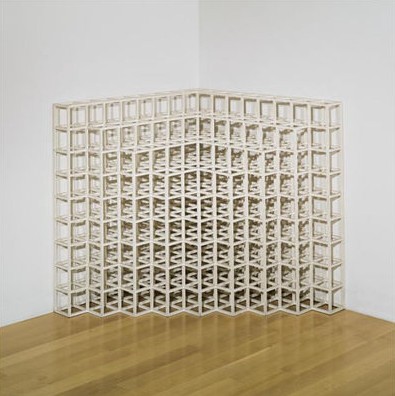
Corner Piece No. 2 (from Cube structures based on nine modules) (2001)
[painted wood]
In a Yale University Press publication that accompanied a 2000 exhibition of LeWitt’s work, the artist attempted to verbalize the philosophy behind his art. Some of his statements seem contradictory at first, but he seems to be begging a fresh way to look at artistic expression:
I will refer to the kind of art in which I am involved as conceptual art. In conceptual art the idea or concept is the most important aspect of the work. When an artist uses a conceptual form of art, it means that all of the planning and decisions are made beforehand and the execution is a perfunctory affair. The idea becomes a machine that makes the art. This kind of art is not theoretical or illustrative of theories; it is intuitive, it is involved with all types of mental processes and it is purposeless. It is usually free from the dependence on the skill of the artist as a craftsman. It is the objective of the artist who is concerned with conceptual art to make his work mentally interesting to the spectator, and therefore usually he would want it to become emotionally dry. There is no reason to suppose however, that the conceptual artist is out to bore the viewer. It is only the expectation of an emotional kick, to which one conditioned to expressionist art is accustomed, that would deter the viewer from perceiving this art.
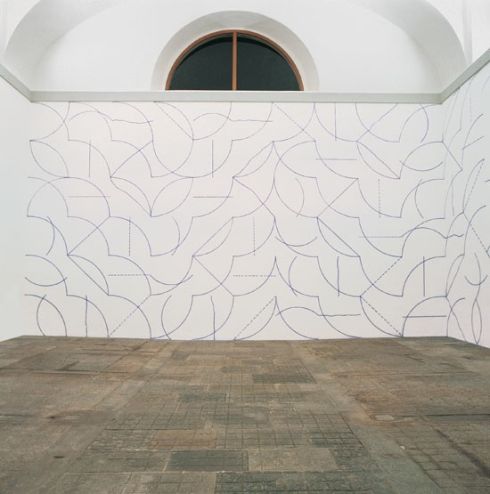
Wall Drawing No. 146 (1972)
[blue crayon]
In 1969, LeWitt summarized his thoughts on his art in a series of statements, titled simply “Sentences on Conceptual Art.” They are succinct and witty, and a sturdy set of guiding principles for both artist and spectator. I found that I violated at least one of them (#18) when I first encountered LeWitt’s work that day at the Fogg.
My advice: read each one, turn it over in your head, think of an application where it might apply – perhaps as it relates to some piece of art you have seen and admire, or a public work of art or architecture that you pass by on a daily basis.
- Conceptual artists are mystics rather than rationalists. They leap to conclusions that logic cannot reach.
- Rational judgements repeat rational judgements.
- Irrational judgements lead to new experience.
- Formal art is essentially rational.
- Irrational thoughts should be followed absolutely and logically.
- If the artist changes his mind midway through the execution of the piece he compromises the result and repeats past results.
- The artist’s will is secondary to the process he initiates from idea to completion. His wilfulness may only be ego.
- When words such as painting and sculpture are used, they connote a whole tradition and imply a consequent acceptance of this tradition, thus placing limitations on the artist who would be reluctant to make art that goes beyond the limitations.
- The concept and idea are different. The former implies a general direction while the latter is the component. Ideas implement the concept.
- Ideas can be works of art; they are in a chain of development that may eventually find some form. All ideas need not be made physical.
(“Sol LeWitt’s Sentences on Conceptual Art” continued)
Tags: ideas
Friday, June 13, 2008
2,000-year-old seed is oldest to germinate
By Wendy Hansen
Los Angeles Times
Scientists using radiocarbon dating have confirmed that a Judean date palm seed found in the ruins of Masada and planted three years ago is 2,000 years old – the oldest seed ever to germinate.
The seed has grown into a healthy, 4-foot-tall seedling, surpassing the previous record for oldest germinated seed – a 1,300-year-old Chinese lotus, researchers reported Thursday in the journal Science.
The little tree has been names Methuselah after the oldest person in the Hebrew Bible. It is now the only living Judean date palm and the last link to the date palm forests that once shaded and nourished the Middle Eastern region.
Dr. Sarah Sallon, who directs the Louis L. Borick Natural Medicine Research Center in Jerusalem, became interested in the ancient date palm as a possible source of medicines. She enlisted Dr. Elaine Solowey of the Arava Institute for Environmental Studies at Kibbutz Ketura to coax the seeds out of dormancy.
One sprouted. Scientists initially estimated its age at about 2,000 years old based on carbon dating of other seeds found at the site, but they had no way of directly testing the planted seed without risking its chance of survival.
After the Methuselah seed germinated, Solowey found fragments of the seed shell clinging to the roots – enough for dating.
The shell fragments initially dated to A.D. 295, give or take 50 years, but a small percentage of “modern” carbon incorporated as the seed germinated made it appear 250 to 300 years younger. Correcting for this factor, the researchers reported that the seed dates from 60 B.C. to A.D. 95, similar to the other seeds from the site.
This story was edited down to fit on the inside front page of the June 13th edition of The Birmingham News. I almost missed it. Then it got me to thinking…
It’s the 4th of July. You’ve gone to an all-day cookout/ball game/3-legged race/beer bust/fireworks display. Sometime during the day, you glom onto an enormous slice of red, juicy watermelon. You devour it with relish, spitting seeds onto the ground left and right. Maybe you’re a little neater than that, and you just spit the watermelon seeds into a Dixie Cup, which makes its way into a garbage can and, eventually, into a landfill. Or perhaps you’re just a little O-C, and stick each seed into the pocket of your Bermuda shorts, dumping them that evening into the compost pile behind the recycling bins in your back yard.
Over time, you die, your family dies, your home disappears, possibly even your neighborhood. The U.S. returns to a natural state after the catastrophic climate event. Forests re-populate, highways fall apart, English becomes the secondary language. Someone conducts an archaeological dig at the site of your house and finds all manner of interesting artifact, including a clump of seeds preserved inside of a cylindrical object made of aluminum alloy, containing traces of Ethyl Alcohol. The seeds get passed on to an agricultural department at the subterranean research facility. They induce one of them to grow, to propagate, and they are planted as a test crop in a floating hothouse. This is how people in the year 4,108 come to enjoy the exact same taste of watermelon that you enjoyed on that hedonistic 4th of July in the early 21st century. Except that they aren’t yet aware of its utility as a sexual enhancement supplement.
The religious implications of the B.C./A.D. crossover date mentioned in the L.A. Times article didn’t escape me, of course. It is indeed nothing short of miraculous that we can today potentially eat food from one of the same trees that may have nourished or sheltered Yeshua Ben Josef or members of his community. That thought gives one a renewed reverence for the passage of time, of history, of the permanence and impermanence of things.
What will they think of us in the year 4,108, as they sit under a solar dome with watermelon juice running down their chins?
Tags: food · history · ideas
[audio:Spain___Make_Your_Body_Move.mp3]
“Make Your Body Move” by Spain, from I Believe (2001)
Fill in the blank:
This song drips with __________.
Tags: music · Random Song Machine
Sunday 9.23.07
I did a lot of walking yesterday. And not just a lot – A LOT!!! My shins and that weird place where the top of the foot meets the lower leg was the sorest of all [possibly radiating from the muscle Extensor hallucis longus]. Eventually, I made my way back to the hotel and put my feet up.
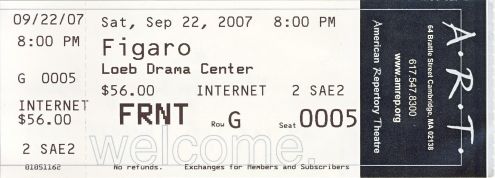
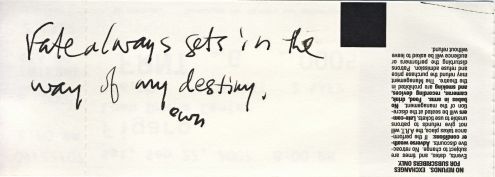
Last night, Figaro at the ART [American Repertory Theatre]. At a point during the show, one of the characters said, “Fate always gets in the way of my own destiny.” In the dark theater, I scribbled it on the back of my ticket.
Afterward, had a cheese slice at Pinocchio’s. Sat on a bench behind the K School and ate it, while watching people walk back from the football game which had just ended.
This a.m. had a mediocre breakfast at Henrietta’s Table, unlike the one on Friday. The service was bland and unattentive. Then went out to the street, after checking out of the hotel, and watched the action at the farmers’ market. Then took the T to the airport – I couldn’t see any sense in paying $40 for a cab when I had so much time and so little luggage.
So, here I am at Logan again, waiting on the plane. Am strangely tired, and would dearly like to spend the night in my own bed, nice as that feather bed at the Charles was.
DB sent me a text message this morning, wishing me a good trip, a C U Soon, and that the Lucinda Williams show at the Alabama Theatre last night was good. I replied that “Boston has been good and makes me appreciate the potential of Bham even more.”
Tags: food · health · house · music · self
Several weeks ago, the Sunday New York Times had a special section about the Emmy Awards so, naturally, I thought that the annual TV awards ceremony was about to be aired. Wrong. As I circled around the interweb, trying to find the date and time of the show (which is not as easy as you might think it would be), I determined that the ceremony is to be held in September. The Times section was merely part of the four-month build-up.
It will be interesting to see how the awards are given out this year, considering the effects of the writers’ strike last year, the resultant drop in original writing, and the overbearing number of reality shows that appeared in the wake. The lingering effects of the strike keep popping up in unusual ways in the news, as documented here, for example. I’ll admit to filling up my increasingly limited TV watching time with more reality television than either I or my friends are comfortable with (that is, when the channel isn’t tuned to MSNBC which is, in its own way, a form of reality TV). But a few new scripted – in the traditional sense – shows have snuck in to my world during this past year, and the standout by a far shot is AMC’s series Mad Men.
It is a rare television program that can pull a viewer into its own universe as well as Mad Men does. The Sopranos and Six Feet Under, two examples from recent years, did this by holding a prism up to the world, placing the audience within a specific cultural pocket (New Jersey mob families and Southern California undertakers, respectively) and looking outward. Mad Men‘s cultural point of origin is the world of Madison Avenue advertising circa 1960. The colorful and layered scripts revel in the slow, rich development of character. Seen in the context of 2008 America, the show has much to say about advances beyond sexism, racism, careerism, and other -isms, in the ensuing 47 years. And on many levels, it also shows us that these advances are relative, and we haven’t necessarily evolved much, aside from our kit bags of electronic gizmos and our hyper-awareness to every minute detail of the lives of others.
Sometimes I watch Mad Men within the context of its time, which happens to be the year that I was born. In the most ego-centric way, I like to think that this was what the world was like when I began, that culturally we have grown together. The series mines this idea elegantly by using cultural touchstones to spark the audience’s collective memory, much like Stephen King attempts to do by inserting song lyrics into his novels, or every politician since Ronald Reagan brazenly does in speech after speech by singling out vignettes of everymen to gain empathy for their policies. The following clip, from the final episode of the show’s first season, may have been Mad Men‘s finest moment so far, and exemplifies its sly blend of drama, sentiment, and marketing:
The second season of Mad Men begins on July 27th, on the American Movie Classic channel.
Tags: TV
The music bursting from my TV set sounded like variations on Richard Strauss’ Don Juan. But not even the overbearing – and gloriously Cinematic – score by Erich Wolfgang Korngold could keep my attention fully diverted from the pile of three past weeks worth of Sunday New York Times, or my feline companion Barbara, who seemed convinced that I was holding a cup full of ice cream, her favorite food (it was merely water, her second-favorite ingestible). Believe me, I tried.
Elizabeth and Essex has an impressive pedigree: marquee actors Bette Davis, Errol Flynn and Olivia de Havilland; future director of Casablanca, Michael Curtiz, at the helm; a stage play by Maxwell Anderson as its source; Korngold’s Austro-Germanic musical influences. As a whole, it just does not enchant to the degree that the Warner Bros. promotional team would have you believe.
Davis, trapped behind a chalky white face of pancake makeup, gets about as much emotional mileage from her facial expressions as would a drunken mime. She resorts to excessive hand-wringing and a variety of other gesticulations to convey her feelings from the screen, opting regularly for the intense stillness of a cardboard cutout. Flynn’s persona is as dashing and dandiful as ever but, with little to act against, he seems lost whenever he’s in the Queen’s prescence. Often the dialogue is shouted and exclaimed as in a defiantly amateurish production of Hamlet.
Surely, the film could not be that bad, you think to yourself, as I did at several moments during my home screening. Two recent films of this same history, Elizabeth (1998) and Elizabeth I (2005), gave us hot-blooded, real characters – with understandable, if disagreeable, motivations – who spoke with a natural cadence. The women inhabiting those versions of the Virgin Queen, Cate Blanchett and Helen Mirren, acted circles around Davis’ performance. I stopped to think how well Blanchett or Mirren might do with Davis’ signature role of Margo Channing in All About Eve. My impression is that they would devour it.
Tags: film · food · history · music · Screenings · TV
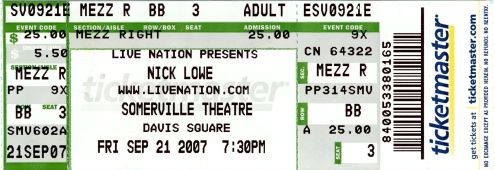
The Somerville Theatre has been re-painted inside, but the rest of the place sorely needs some TLC. The seat of the chair belonging to the guy in front of me kept falling off of its hinges onto the floor. When Ron Sexsmith came out, the place was only half full, and he commented on that. He was playing a solo acoustic set (as was Nick Lowe later). Ron played nearly all of my favorite songs, including “Strawberry Blonde” and “Lebanon, Tennessee.” He did that same thing that I’ve seen him do every time he’s played solo, including the in-store at Laser’s Edge, and that is to announce that he’s playing without a set list. Immediately, everybody – or several bodies – shouted out song requests. And he molded a set list out of that. That’s an extremely free and versatile way to put on a show. He was wearing the same burgundy jacket that I’ve seen him wear at least once before.
Nick Lowe had on black shoes, black slacks (maybe dark gray), and a crisp white shirt with a wide collar. He started with “People Change,” and I knew at that moment that this was going to be a great set (I love that song!). And he played all (no exaggeration) of my very favorite songs. – Oh, I forgot to mention that Ron played his own version of Nick Lowe’s “Where’s My Everything?” during his set. He said he’d asked Lowe if he would sing it, Nick told him it wasn’t on his list this tour, so Ron asked if he could sing it. – Lowe even played “Indian Queens,” which may be my absolute favorite of his, and it was graced by a lengthy introduction that no other song got. Another validation for my tastefulness. (wink.) He gave us two encores, and during the first, Ron came out and duetted on a country-type song called “My Baby’s Gone” (that’s a guess) that they had just learned to play together. It was charming. [The song was “My Baby’s Gone,” written by Hazel Houser, and somewhat of a hit in the recording by The Louvin Brothers.]
Came back on the T to Harvard Square, bought a Crimson and Globe at Out of Town News and took them back to the hotel to read. Crashed.
This a.m. I got up and went down to The Dunk for a “medium regular.” Man, they still make ’em exactly as I remember. Delicious!! There may not be a better cup of coffee anywhere in the world, except at some other Dunk. I sat for awhile on their veranda and watched the comings and goings from the Kennedy School and along JFK Street.
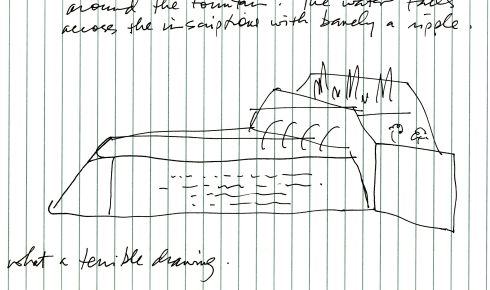
I am writing this by the fountain at JFK park, which I don’t remember at all. The park, that is. The signs say the park was dedicated in the spring of 1987, so that was just a few months before I moved away from here. It is a lovely parcel, right behind the Charles Hotel, next to the Charles River, and on the corner of JFK Street and Memorial Drive. The Harvard Crew boathouse is right across the river from this spot, and in plain view. The women’s crew has been practicing load-up and carrying the shells from the house to the water. It’s fun to watch, and reminds me of our Quincy House crew and racing on the Charles. And throwing our coxswain Joanne Vogel into the river after the race.
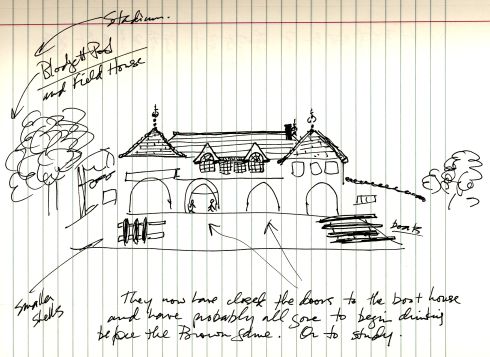
The JFK fountain is beautiful and so simple. It looks kind of like a bed. Inscriptions from JFK’s speeches are carved into the stone all around the fountain. The water falls across the inscriptions with barely a ripple.
Tags: food · music · self


