

Protected: Pat to Ida: 25 April 1944
July 18th, 2009 · Enter your password to view comments.
Enter your password to view comments.Tags: Ida & Pat
Kittens!…inspired by…Kittens!
July 17th, 2009 · 5 Comments
Okay, so this is just a video post, but I dare you not to laugh!
And here’s another kitten-themed vid, which I dedicate to Stu:
→ 5 CommentsTags: books
Protected: Pat to Ida: 24 April 1944 (letter 2)
July 16th, 2009 · Enter your password to view comments.
Enter your password to view comments.Tags: Ida & Pat
Oceanside sunset: 20 December 2008
July 15th, 2009 · No Comments
I captured this little scene while on the balcony of a condo during a gathering of high school friends in Oceanside, California. The photographer in the lower left-hand corner makes this video oddly self-referential: I was also using a tripod. Notice how he cues me that the filming has come to an end.
I also like the occasional seagulls, and the reflection of the sunset on the wet sand.
This clip is best viewed with the sound off, unless you want to hear our party chatter.
→ No CommentsTags: My Eye
Protected: Pat to Ida: 24 April 1944 (letter 1)
July 14th, 2009 · Enter your password to view comments.
Enter your password to view comments.Tags: health · Ida & Pat · music
Reunion Journal: 31 July 2008, part 2 (Getting There)
July 13th, 2009 · No Comments
(continued from Reunion Journal: 31 July 2008, part 1)
I sink deep into my window seat, book in lap. The Diving Bell and the Butterfly is a slim book, and the typeface is medium to large, each finely wrought word and phrase luxuriating in the white space on the page. It is easy to identify with the book’s protagonist and author Jean-Dominique Bauby, in full-body paralysis, as I am wedged between the triple-pane airplane porthole and Diane and Walter, curled up in a human ball next to me with their DVD player.
As the DVD logo fades and the film begins, I turn from the screen to the book. The prose reads quickly, and the pages turn steadily. I look over at the DVD screen from time to time. Babel is strangely involving as a silent movie, with its striking color palette and widescreen landscapes. I watch for a few minutes at a time, but the book pulls me back.
The lighthouse and I remain in constant touch, and I often call on it by having myself wheeled to Cinecittà, a region essential to my imaginary geography of the hospital. Cinecittà is the perpetually deserted terrace of Sorrel ward. Facing south, its vast balconies open onto a landscape heavy with the poetic and slightly offbeat charm of a movie set. The suburbs of Berck look like a model-train layout. A handful of buildings at the foot of the sand dunes gives the illusion of a Western ghost town. As for the sea, it foams such an incandescent white that it might be the product of the special-effects department.
I could spend whole days at Cinecittà. There, I am the greatest director of all time. On the town side, I reshoot the close-ups for Touch of Evil. Down at the beach, I rework the dolly shots for Stagecoach, and offshore I re-create the storm rocking the smugglers of Moonfleet. Or else I dissolve into the landscape and there is nothing left to connect me to the world than a friendly hand stroking my numb fingers. I am the hero of Godard’s Pierrot le Fou, my face smeared blue, a garland of dynamite sticks encircling my head. The temptation to strike a match drifts by, like a cloud. And then it is dusk, when the last train sets out for Paris, when I have to return to my room. I wait for winter. Warmly wrapped up, we can linger here until nightfall, watch the sun set and the lighthouse take up the torch, its hope-filled beams sweeping the horizon.
Eventually, I crest the 100th page. Almost in time with my milestone, I hear a gasp from the seat next to me. Diane has her hand over her mouth, stifling a gasp, while Walter is flipping a switch back and forth on the front of the DVD player. He eventually stops and announces that the battery power has expired. I listen to their conversation about it, and imagine how hard it must be to sustain a conversation for more than 30 seconds about a DVD player losing battery power. It occurs to me that my laptop computer has DVD play capability and is fully charged. I tell them so. They accept my offer to use it to finish the film.
Once the film is set up on the computer, I return to my book.
About fifteen minutes from Las Vegas, the battery power on the laptop fades. Diane and Walter are ten to twenty minutes from the end of the film. There is a collective groan of “Aahh!” in our row. I pack up the computer. As we taxi toward the terminal, I pull the BlackBerry from my backpack and check my e-mail. There is a form-letter message from Bill Clinton’s office, pushing the Democratic agenda for the upcoming election.
“Whaddaya know, I just got an e-mail from Bill Clinton!” I say, out loud.
Walter leans forward and looks past Diane toward me, a raised eyebrow accenting his haughty facial expression. Diane leans into the back of her seat, spine rigid, seeming to brace herself for the shitstorm to come. Walter then launches into a verbal attack that is borderline personal, seeming to portray every American with an annual take-home income below $300,000 as sub-human, blaming the Democratic Party for every ailment from terrorism to corporate failures to venereal disease.
At this point, mercifully, a voice comes over the plane’s intercom system. “This is your Captain Haphazard. We regret to inform anyone continuing on to San Diego that this aircraft will not be flying the remainder of your route as planned. Please disembark and the airline representative at the terminal gate will direct you to your connecting flight.”
We gather our belongings and march off the plane into the Las Vegas airport terminal, the vestiges of abandoned, unsolicited political rhetoric flopping with the last impulses of life on the cabin floor.
(continued at Reunion Journal: 31 July 2008, part 3)
→ No CommentsTags: books · film · politics
Protected: Ida to Pat: 23/24 April 1944
July 12th, 2009 · Enter your password to view comments.
Enter your password to view comments.Tags: food · Ida & Pat
Hungry cat
July 11th, 2009 · No Comments
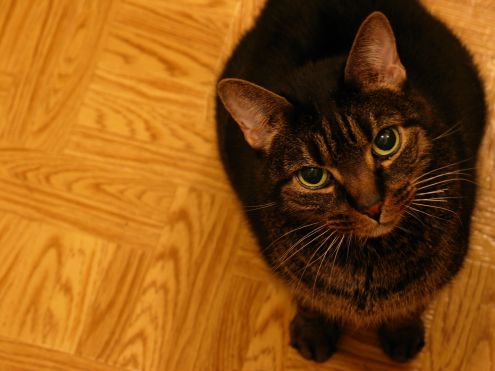
(photo: spitballarmy.com)
Photo taken on 28 December 2008. Ziggy, at 13 years and three months, begging for food by staring me down – his most practiced and perfected activity.
→ No CommentsTags: My Eye
Protected: Ida to Pat: 23 April 1944
July 10th, 2009 · Enter your password to view comments.
Enter your password to view comments.Tags: food · Ida & Pat · music
Sawed-Off Pimple Dance, with Flute
July 9th, 2009 · No Comments
Transcribing correspondence from the World War II era, starting with that of Beverly Anderson, has been an ongoing, truly enjoyable experience for me, and an educational one. I have always had a fascination with history, particularly cultural history, and find the War era especially rich. “Ancient” American culture is a puzzle: discovering what was once in vogue, what customs we have retained, what practices have fallen by the wayside. I have been particularly surprised with phrases and sayings from this period, some familiar and some that might as well be in a foreign language.
I was propelled into thinking about this recently when I transcribed a letter dated 6 February 1944. In it, an Italian-American housewife, living in New England, is writing to her husband, stationed at the Sampson Naval Training Station in New York. In the last sentence, she refers to their precocious, nearly two-year-old daughter:
Reason for stopping before – A., T. & C. [friends or relatives] came over. They waited for my folks & left at 11:30. That’s when I tried to put the sawed off pimple to sleep.
Sawed off pimple? That was a new one to me. The imagery was ugly and, I assumed, particularly unkind, especially when referring to one’s own child. I thought that, perhaps, my own mother – who was nearly a teenager at the time this letter was written – might have heard the phrase in her youth and could explain to me where it had come from. I telephoned her.
Hi, Mom.
Oh, Hi! (With a drawn-out “i.” This is the standard first response when I get Mom on the phone.)
I filled her in on why I was calling. She checks in on the blog occasionally but is still working on a dial-up connection, so she has neither the technical capability or the patience necessary to load and utilize a lot of the sound and vision peppered throughout the website. But if it’s in text form, she’s probably read it. This was a relatively new posting, so I gave her a little background about the little girl who eats tooth powder and shoves toothbrushes down the toilet, then read the letter to her. Her response was immediate.
That’s disgusting. What was she talking about?
It sounds like a slang term for the kid, as if she was being annoying. But “sawed off pimple?” That seems a bit extreme. Did you ever hear that spoken when you were growing up? (Mom’s childhood was spent in northeast Texas, primarily.)
No, never.
We both thought that maybe it was indigenous to the northeast United States, the area from which the letter-writer originated. I had a thought.
Isn’t your friend, Kitty, from New York? Maybe you could ask her if she’s ever heard that phrase.
I would never say such a terrible thing to her. Besides, she’s from Virginia.
First attempt unsuccessful, I thought I might try what should have been obvious at the beginning. I googled “sawed off pimple.” I got one entry, one entry alone, not from the internet, but from my local network.
It was the letter I had just transcribed.
I tried it again, this time with a hyphen, or dash: “sawed-off pimple.” This was probably the proper spelling presentation, anyway (I thought…about a phrase that, so far as I could tell, no one but this mid-20th century woman seems to have utilized).
The results were the same.
Could I have come across a linguistic phrase that had only one Italian-American family as its progenitor? Could the phrase have died with them? Will its genesis remain a mystery to me? Would William Safire have the resources to answer these questions if I wrote to him?
Maybe. Maybe. Maybe. Hey!
I will write Mr. Safire a letter. And I did, via e-mail (safireonlanguage@nytimes.com):
Dear Mr. Safire:
I would like to say at the outset of this note that I look forward to reading your New York Times column every Sunday. I consider myself poorly versed in the academic subject of etymology, but your cultural approach to language makes me feel that I do indeed have a base from which to understand the origin of words and phrases.
As a hobby, I collect and transcribe correspondence from the World War II era. I have recently come across two phrases for which I am unable to find any source or cultural footing. Would you consider helping me in my sleuthing?
“Sawed off pimple”
This phrase was used in reference to a young girl of no more than two years old who, busy as a child of that age can be, was into everything (eating tooth powder, shoving brushes into the toilet, not sleeping) and being a general annoyance to her mother. The imagery provided by this phrase is “bloody” awful, triggering in my mind an image closer to Freddy Krueger than the Gerber baby.
The mother refers to the child as a “sawed off pimple” in a letter written on February 6th of 1944. The family lived in north central Connecticut, due south from Springfield, Massachusetts. They are of Italian descent. Using multiple internet search engines, I have found no citation or other source using this phrase, either as it is written or hyphenated as “sawed-off pimple.”
“Flute dance”
I found this phrase and some variations on it used in letters written by a Minnesota woman [Beverly Anderson] to her husband circa 1943. The phrase is always used in her closing salutations. Here are some examples:
“How about a series of “flute dances?” “
“Have fun. But take good care of yourself. How about another flute dance? “
“Good night, Sweet’art. Pleasant dreams. Join me in a flute dance? “
“Please be careful – hurry home – I’ve got 100 flute dances saved up – can you take that many?”
Again, I have found no reference to usage of this phrase in any way other than in strictly musical terms. I have considered the possibility that the writer is indeed referring to a piece of music – “their song,” perhaps – but the implicit sexual innuendo is hard to ignore. I am wondering if this may refer to a 1940s analogue of the late 1980s Lambada “forbidden dance” craze.
Thank you for your time, and I am hopeful for your reply.
Almost immediately, I received the following automated response:
Dear Lexicographic Irregular,
You were good to respond to my invitation for comments and suggestions. A great many other readers have pitched in, too. Although I can’t answer mail individually, I read every letter and am most grateful for yours.
Sincerely,
William Safire
And, so, I wait, with the lingering close-up mental image of someone messily slicing a bump from the surface of their skin, and a Sigmund Freud paraphrase being paraded like a banner, floating back and forth across the terrain of my mind: Sometimes a flute is just a flute.
Meanwhile, if you, dear reader, have heard either of these phrases used in a similar context or have an inkling as to their origin, please feel free to chime in with a comment below.
To be continued…(hopefully)
→ No CommentsTags: Bev & Ande · history · language
