January 10th, 2008 · 1 Comment
No, it’s not what you’re thinking.
GUAM [1975-1976] Guam was the band name informally given to the great assemblage of musicians Dylan took on the Rolling Thunder Revue tour of 1975 and 1976. Alternative names considered and/or given out in jest were the Budweiser Revue, Somebody & the Flaming Corks and MC & the Ushers. In 1975 Guam comprised: Bobby Neuwirth, Scarlet Rivera, T-Bone Burnett, Roger McGuinn, Steve Soles, Mick Ronson, David Mansfield, Rob Stoner, Howie Wyeth and Luther Rix. For some reason Joan Baez, Ronnie Blakley, Ramblin’ Jack Elliott and Allen Ginsberg were generally not considered part of Guam.
In his Rolling Thunder Logbook, Sam Shepard tags Guam as ‘Neuwirth’s miraculous band of street thugs.’ In 1976 the line-up was unchanged except that Luther Rix was replaced on congas by Gary Burke.
Another nugget from Michael Gray’s The Bob Dylan Encyclopedia. This book is my current favorite browsing volume, and I am finding things out about Dylan and within the Dylan orbit that I never could have imagined. Other surprising entry headings in this “reference” book:
- Carl XVI Gustav of Sweden [1946- ]
- nursery rhyme, Dylan’s use of, pre-1990
- Yearwood, Trisha [1964- ]
- Chabad telethons
- book endorsements, unfortunate
Tags: music
From The Bob Dylan Encyclopedia by Michael Gray:
Interviews and the myth of their rarity It’s always been a myth that Dylan interviews are rare: they average about one a month for all four and a half decades of his career. That’s something over 500 interviews and press conferences given, written up and published, and in many cases recorded and/or broadcast or telecast. And since the mid-1960s almost every one is published prefaced by the claim that it comes from a man who rarely gives interviews.
Tags: music
I came home today to find the new issue of American Record Guide in my mailbox. It was a welcome arrival.
Much as some people go first to the sports section of the newspaper, or to the technical credits of a CD booklet, I race to the Critical Convictions column of this bi-monthly classical music journal as soon as I tear off the plastic pouch protecting it. The editor-in-chief of ARG, Donald Vroon, puts heart, soul, reason and no small amount of venom into his regular essay on the state of culture, in general, and the classical music world, by default. I have frequently gasped out loud at some of the brash – and sometimes abrasive – statements he has made regarding the downward spiral that the arts in our country has taken during the last few decades – it is most often a brilliantly-constructed melodrama of horror and truth. This evening I gasped for a different reason: someone else had written Vroon’s column!
As it turns out, Vroon’s absence was filled quite adequately by Dana Gioia, chairman of the National Endowment for the Arts. Mr. Gioia’s ARG column, entitled “The Impoverishment of American Culture,” is a condensed version of his June commencement address at Stanford University. Here are some key points, from an article with key points peppered within it like so many minefields:
The loss of recognition for artists, thinkers, and scientists has impoverished our culture in innumerable ways, but let me mention one. When virtually all of a culture’s celebrated figures are in sports or entertainment, how few possible role models we offer the young. There are so many other ways to lead a successful and meaningful life that are not denominated by money or fame. Adult life begins in a child’s imagination, and we’ve relinquished that imagination to the marketplace.

(photo: L.A. Cicero)
At 56 I am old enough to remember a time when every public high school in this country had a music program with choir and band – usually a jazz band, too, and sometimes even an orchestra. … I am sorry to say that these programs are no longer widely available. This once visionary and democratic system has been almost entirely dismantled by well-meaning but myopic school boards, county commissioners, and state officials, with the federal government largely indifferent to the issue. Art became an expendable luxury, and 50 million students have paid the price. Today a child’s access to arts education is largely a function of his or her parents’ income.
The real purpose of arts education is to create complete human beings capable of leading successful and productive lives in a free society. This is not happening now in American schools. What are we to make of a public education system whose highest goal seems to be producing minimally competent entry-level workers?
A melodrama of horror and truth, indeed! While reading Gioia’s column, I could not shake the image of hundreds of mortar-boarded Stanford grads, sitting in distracted attention, texting one another during this spoken address with details of that evening’s festivities.
I have nothing against Stanford, even though both of my siblings went to USC (which had the superior football team at the time). Indeed, the recollection of my own commencement includes our Class Day speaker Mother Teresa, whose message of service and love was a hard sell to a class who were more focused on meeting July’s rent on their new apartment or shuttling visiting family members around Cambridge than on the lasting impact of charitable acts. The rewards of heaven were much less tangible at that time than the consolation of an adequate paycheck.
Nonetheless, in the 25 years since that day, the state of popular culture has fallen to such a lamentable level that there is not much for an individual to do about it other than, well, lament. A glance at the best-seller charts for music and books give us CDs filled with vapid pelvis-swinging beats and formulaic thrillers with unchallenging chapters designed to do little more than occupy the reader on a bus ride to work. No poetry, no lyricism, and a barely distinguishable heartbeat. Sure, there are exceptions, but they are standouts because they are rare. I have no argument at all with Mr. Gioia’s thesis.
The full text of Dana Gioia’s address can be found here.
I strongly encourage you, if you are interested in keeping up with the happenings in the very rich world of classical music and opera, to investigate the American Record Guide – you can subscribe to receive their publication in your mailbox, and gain access to the magazine’s online archives, by visiting their website. Read it, share it with someone you know, then take a student to the symphony, to your community theater, to the museum, to a book or poetry reading…
Tags: ideas · music
My exposure to W.C. Fields was limited to the multiple viewings of Never Give a Sucker an Even Break that I enjoyed when I was a kid. That ridiculous, episodic and barely comprehensible film was on TV all of the time then, and is still one of my favorite comedies, even though I couldn’t tell you much about it that would make sense. Let’s see, there were two women living on top of a mountain with a gorilla, a rude waitress, a game of squigilum, and the caustic term of endearment “blimpie-pie.”
My W.C. Fields deficit was relieved slightly today, after I watched his hilarious 20-minute short, The Fatal Glass of Beer. The notes on the DVD package describe the film as a spoof of Yukon melodramas (as if anyone younger than your grandparents knows what those are). On my first viewing, I had no idea what was going on – the opening scene has Fields, in a miserably cold prospector’s shack, singing a song to a fellow miner while accompanying himself on an autoharp, while wearing mittens – so I watched it again.
During the next viewing I was still scratching my head over some of the dated humor, and wondered if the poor sound quality might have been obscuring some of the punchlines. I laughed anyway. Even during the brief sequence where Fields discovers two Indians squatting inside his cabin. No doubt, this scene would be labelled as politically incorrect today. But I laughed anyway. And how.
One of the many recurring gags in this short is Fields getting a handful of snow thrown in his face every time he opens his cabin door and states, “It ain’t a fit night out for man or beast!” This kind of silliness always gets a chortle out of me. He also has a three-foot long piece of bread that he busily dunks in his soup bowl through half of the film, but never takes a bite from. Watching the frustration on Fields’ face each time he raises the soggy bread to his lips, only to get yet another interruption – nobody does that slow burn so well. And a 30-second series of “good nights” between Fields, his wife, and son Chester, could have been a model for the closing moments of an episode of The Waltons (except that, here, it is hysterical).
Once the city gets into a bohoy’s syhystem, he loses his ahankering for the cohuntry.
I think I’ve watched this little movie four times now, and I am struck by how richly entertaining it is without the aid of color, special effects, or any visible budget – I reckon, guess and calculate that it’s all in the intentionally hammy overacting and the inspired wordplay.
I went to the movie theater on New Year’s Day to see Juno, and before the film started, we were subjected to 30 minutes of commercials and previews. If I had seen something like this instead – in the same way that serials and newsreels were shown before a film in the early part of the last century [that makes it sound like a really long time ago, doesn’t it?!] – then I know that I would have enjoyed the feature even more.
Tags: film · language · Screenings
5 May 2009 UPDATE:
This post is one of the most visited on this website, primarily by people using search engines to comb the ‘net using the phrase “subliminal advertising.” If this statement applies to you, please feel free to leave a comment below telling me what propelled you into this search (a class assignment, etc.). I am curious. Thanks!
Now, on to our regularly-scheduled post:

St. Vincent’s Bruno Cancer Center billboard
downtown Birmingham, Alabama, west of I-31
(photo: spitballarmy.com)
On 31 December 2007, I wrote:
This billboard is an example of brilliant subliminal advertising. Anybody out there willing to put yourself on the line and lay out what you think is at work here? I have my ideas…but I’ll wait to see if anyone is game to play first.
Talk to you soon.
And ABE – putting it all on the line – responded:
Maybe they are hoping you’ll want to meet the pretty lady?
Well, ABE, you’re on the right track – the pretty lady is the “gatekeeper.”
I had been driving by this billboard on my way to work almost daily for the past month, before its method seemed to !POP! in my head. You see, I had noticed the apparently unclad woman, the St. Vincent’s logo, and the word cancer, and assumed that the billboard was promoting the hospital’s breast cancer center. Very recently, I realized that there was nothing on the billboard that indicated a focus on breast cancer at all! Instead, there was the tag line (“Where Hope and Medicine Meet”) in type two times the size of the product line (“St. Vincent’s Bruno Cancer Center”). No specific mention of breast cancer anywhere. However…
In the tag line, the words Hope and Medicine are emphasized in boldface type, and stand out from the other words. Anyone driving by and glancing quickly would most likely notice the woman’s photograph and those two words first. Then, subliminally, they might make the following association, as I did –
Hope -> chest
Medicine -> chest
– reasonably leading to the assumption that this is an ad having something to do with cancer of the chest, er, breast. They needn’t read any of the other fine print to come to that conclusion.
I love ads like this – to me, it is like a puzzle being offered by the ad agency to see if I can figure out their thought process while they were creating the ad. That is, if they were conscious of what they were doing. I would bet that they were. And, yes, I watched Mad Men – some episodes twice.
Tags: signs
January 6th, 2008 · 1 Comment
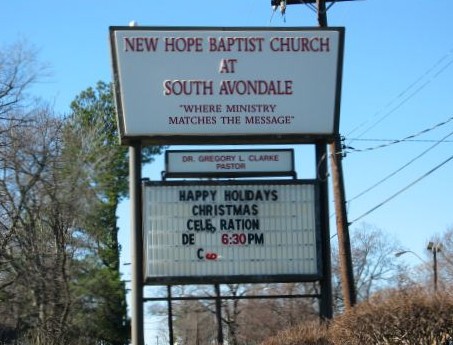
New Hope Baptist Church, Birmingham, Alabama
(photo: spitballarmy.com)
Ah, yes, that recent Christmas celebration at the church. Remember? It was so much fun, until it all fell apart at the end.
Tags: signs
January 5th, 2008 · 1 Comment

No, the title of this post doesn’t refer to the band in the photo – it’s the Spanish translation of the title of the following song by the fabulous BellRays, a little ray of sunlight provided by your friend at Spitball Army headquarters. This was recently re-discovered on my Random Song Machine (aka iPod). Oh boy, have I ever felt like this on many many occasions, as I would guess several of you have (but may not have been willing or able to express it at the time).
[audio:Bell_Rays___Stupid_Fucking_People.mp3]
Of course, gentle reader, I am keenly aware that this conflicts with yesterday’s post about everyday kindnesses, but I would attempt a persuasive argument that I can have it both ways.
Tags: language · music
January 4th, 2008 · 1 Comment
Last week I received, in the mail, a press package from an independent musical artist going by the name, Gileah and The Ghost Train (check out her/their music on myspace). The envelope contained the CD (in a classy digipak) and a semi-personalized note. In the note, the artist’s music is compared to The Cardigans, Rilo Kiley, The Sundays and Cat Power – I am on board with the Rilo Kiley comparison, but think the Cat Power one is a bit of a stretch – but what made me pause while zipping through the materials was the closing of the note:
From the bottom of my heart I thank you for your time…
Blessings on your head.
Gileah
Well, I thought, that sounded nice: blessings on my head. I don’t know what it means, but it sounds kind and gentle.
So, I did what I normally do when I need an answer to a vexing question – I went to Google! We used to, when I was in grade school, have contests where we were posed with a question that required the gathering of information, and the students involved raced to the Encyclopedia Brittanica or World Book Encyclopedia volumes, flipping pages until the answer was scribbled down and the volumes re-shelved. Today, that cumbersome process has become as easy as typing a few characters into the Google toolbar.
Anyway, being a man of the times, I typed “blessings on your head” into my toolbar, and here is some text from one of the entries that came up:
The word “blessing” is found in many places; some pleasant and entertaining, and some more troubling. Remember in Fiddler on the Roof, when Tevye reports his nightmare in which his wife’s mother, may she rest in peace, surprises him by telling him that his daughter is going to marry someone other than the butcher’s son?
A blessing on your head
(Mazel Tov, Mazel Tov)
To see a daughter wed
(Mazel Tov, Mazel Tov)
And such a son-in-law
Like no-one ever saw
The tailor Motel Camzoil
Oy, of course I remember that movie. The author of this presentation further explains his example:
In the context of the musical, “blessing” is ironic, but it’s a light-hearted catchy melody. Likewise we feel a spot of warmth in our hearts, like a touch of whiskey from the emerald isle, when we hear an Irish blessing, as well as the implicit blessing in Curran’s naming “and may life be for you, one long sweet song.”…
…However, “blessing” for many of us may have some sour associations. Does you stomach turn when some politician ends his or her speech with “Thank you, and God bless America”? Or singing “God bless America” along with “Take me out to the ball game” during the seventh inning stretch? Why am I troubled? Too often it feels like smug self-assurance. “Look at us – me! We’re so blessed. We are God’s favorites, not like those God-forsaken sinners in other parts of the world.” I get angry because I would like our leaders and our nation to be more humble, to invite the kind of self-criticism that the prophets brought to the kings and peoples of old. “How can you say “God bless America” when your decisions kill thousands abroad, and deepen the poverty and hopelessness of millions here at home?” How about “and God have mercy on us”?
Fair enough. Rev. Ratzlaff goes on to quote extensive passages from the writings of Rachel Naomi Remen, a medical doctor who counsels cancer patients, who has written books including Kitchen Table Wisdom:
As a young doctor, I thought that serving life was a thing of drama and action and split-second judgment calls. A question of going sleepless and riding in ambulances and outwitting the angel of death. A role open only to those who have prepared themselves for years. Service was larger than ordinary life, and those who served were larger than life also. But I know now that this is only the least part of the nature of service. That service is small and quiet and everywhere. That far more often we serve by who we are not what we know. And everyone serves whether they know it or not.
We bless the life around us far more than we realize. Many simple, ordinary things that we do can affect those around us in profound ways: the unexpected phone call, the brief touch, the willingness to listen generously, the warm smile or wink of recognition. We can even bless total strangers and be blessed by them. Big messages come in small packages. All it may take to restore someone’s trust in life may be returning a lost earring or a dropped glove.
This was pretty much the place where I was expecting to arrive. My impression of Gileah’s salutation wasn’t one rooted steadfastly in any particular religious tradition. It felt like a spiritual nod. And, whether it was or not, I have chosen to accept it that way.
We can even bless total strangers and be blessed by them. Big messages come in small packages.
This was not a turning point in my life, or even a “lightbulb” moment of realization. Just a dot of affirmation at a moment when it could be noticed and appreciated.
Perhaps, somehow, I can quietly pass it on.
Tags: film · language · music
- Cat Power Jukebox [Matador] (scheduled for a January 22nd release)
- Drive-By Truckers Brighter Than Creation’s Dark [New West] (January 22nd)
- the re-issue of The Feelies Crazy Rhythms [Water] (January 22nd)
- Shelby Lynne Just A Little Lovin’ [Lost Highway] (January 29th)
- Pat Metheny Trio Day Trip [Nonesuch] (January 29th)
- Jack Johnson Sleep Through The Static [Brushfire] (February 5th)
- the re-issue of Nick Lowe Jesus Of Cool [Yep Roc] (February 19th)
- Lizz Wright The Orchard [Verve Forecast] (February 26th)
- Jackson Browne Solo Acoustic, Volume 2 [Inside Recordings] (March 4th)
…and having to drive to either Atlanta or Montgomery to see the film I’m Not There at the end of the month.
I’m just now starting to notice and investigate what new music is on the way for the coming months. It looks OK.
Tags: film · music
It’s just an annual ritual – like having the chimney cleaned. And, though it doesn’t keep the house from burning down, writing down a musical Top 10 gives me a record of the evolution of my own taste (I was going to say that it also gives me a snapshot of the evolution of trends in popular music, but I don’t think that is the case). I’ve got a pile of these lists, going back decades, and it’s sometimes an unwelcome jolt to see the music I was championing back then. Other times, it’s the trigger that forces out a barely audible “Aw,” then a scramble to find that recording I haven’t heard in ten years. Anyway (SNAPSHOT!!), here’s the 2007 list:

1. Nick Lowe At My Age
– I was fortunate enough to see his solo acoustic show at the Somerville Theater in Massachusetts this past September, and it was magnificent (didn’t hurt that the opener was Ron Sexsmith).
2. Vulture Whale Vulture Whale
– Rock & Roll as it should be: loud, unrefined, with a sense of humor. And they’re from Birmingham.

3. Josh Ritter The Historical Conquests Of Josh Ritter
– Josh Ritter merely breathes and beautiful music comes out. My other favorite concert of the year was JR at both Workplay and Laser’s Edge on Halloween night. Transcendent.

4. Ryan Adams Easy Tiger
– Pure poetry by our most troubled bard. God help him (and keep him).

5. Laura Veirs Saltbreakers
– This and the Ry Cooder title (below) are the most “album”-like on the list, containing songs that flow together thematically or, in the case of Buddy, tell an engaging story.

6. Ry Cooder My Name Is Buddy
– Rumor has it that one of Ry Cooder’s new projects is based somehow in Alabama. But it’s just a rumor.
7. Band Of Horses Cease To Begin
– My instant access to this album was the sonic similarity to The Shins, but Band Of Horses don’t seem enamored of their own quirkiness. “Detlef Schrempf” is one of the most touching moments that I heard on a rock album this year.

8. The Avett Brothers Emotionalism
– The first Avetts album to approach the energy and spontaneity of their explosive live show, beautifully balanced between the convulsive and the tender.
9. Lewis Taylor The Lost Album
– The history of this recording is somewhat mangled, but THANK GOD it got released. The Lost Album is Taylor’s painstakingly crafted homage/pastiche to Brian Wilson and Todd Rundgren, injected with enough neo-soul vibe to keep it from being a tribute retread.

10. Daniel Lanois Here Is What Is
– This soundtrack to a documentary about Lanois and his music has moments of jaw-dropping beauty.
What were your favorites last year?…Feel free to post them as a comment.
Tags: music


