A six-month follow-up to the events recorded in this post, from today’s Seattle Times:
MIDDLEBURY, Vt. — Call it poetic justice: More than two dozen young people who broke into Robert Frost’s former home for a beer party and trashed the place are being required to take classes in his poetry as part of their punishment.
Using “The Road Not Taken” and another poem as jumping-off points, Frost biographer Jay Parini hopes to show the vandals the error of their ways — and the redemptive power of poetry.
“I guess I was thinking that if these teens had a better understanding of who Robert Frost was and his contribution to our society, that they would be more respectful of other people’s property in the future and would also learn something from the experience,” said prosecutor John Quinn.
Read the full article here.
Tags: books · house · language
In which Fred Schneider of The B-52’s sings – to a “Love Shack” beat – excerpts from former White House press secretary Scott McClellan’s recently published book:
That was inspired. But too bad no one heard the plug for the new B-52’s album.
The name Scooter Libby will never sound quite the same to me.
Now, can we also hear these great literary moments interpreted in the same way, please?
- “This hobbit was a very well-to-do hobbit, and his name was Baggins.” [J.R.R. Tolkien, The Hobbit]
- “Persons attempting to find a Motive in this narrative will be prosecuted; persons attempting to find a Moral in it will be banished; persons attempting to find a Plot in it will be shot.” [Mark Twain, The Adventures of Huckleberry Finn]
- “Sometimes, the candle barely out, my eyes closed so quickly that I did not have time to tell myself: “I’m falling asleep.”” [Marcel Proust, Swann’s Way]
I see the budding of a vibrant new career for Mr. Schneider.
Tags: books · fiction · music
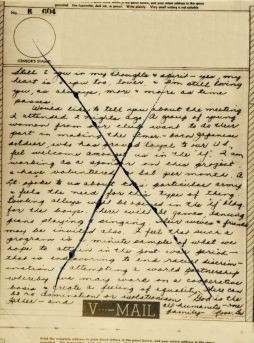
June 3, ’43
Still with you in my thoughts and spirit – yes, my heart is with you too, Lover and I’m still loving you, as always, more and more as time passes.
Would like to tell you about the meeting I attended 2 nights ago. A group of young women from our Club want to do their part in making the Amer.-born Japanese soldier, who has proved loyal to our U.S. feel welcome amongst us in the ‘Y.’ I am working as a sponsor on this project and have volunteered a Sat. per month. A Lt. spoke to us about this particular army and feels the need for this type of thing. Bowling alleys will be opened in the ‘Y’ bldg. for the boys. There will be games, dancing, piano playing, and singing. Their wives and friends may be invited also. I feel that such a program is a minute sample of what we hope to attain in the post-war period – that is endeavoring to end racist discrimination and attempting a world partnership whereby we may work on a cooperative basis and create a feeling of equality. There can be no domination or isolationism. God is the Father – and all humanity – one family –
Love,
Bev
Tags: Bev & Ande · politics
The collective sigh of relief after hearing that Teddy Kennedy’s cancer surgery went well gave way to a wave of more detailed information describing what actually went down in that Duke University operating room. The New York Times has an interesting article, posted today (for tomorrow). This excerpt was very exciting:
In tumor removal surgery, these experts said, doctors at elite institutions use sophisticated imaging technology to produce a precise, three-dimensional picture of the tumor. They put the patient under anesthesia and cut away a piece of the skull just above the tumor. They then awaken the patient, and probe the area around the tumor to see exactly which parts of the brain are crucial for normal functioning.
If the tumor is in the parietal lobe — which was the case for Mr. Kennedy — doctors typically stimulate a series points on the surface of the exposed region while having the patient speak or identify words. This allows the surgical team to map the precise areas that support language and to preserve them. Each individual’s brain is slightly different, so each patient must be directly tested to mark the critical brain areas, which are often tagged with little paper markers.
In 2006, members of the Duke team published a study suggesting that, with careful imaging techniques, they could map language areas before opening the skull; in 6 of 37 patients tested, the imaging enabled a more complete removal of the tumor “than otherwise would have been achieved,” the authors reported.
The challenge for the surgeon in any such surgery is to remove as much of the tumor as possible, while avoiding the sensitive areas.
In other words, it’s kind of like playing “Operation!” I, of course, am not wishing to make jokes at the expense of Senator Kennedy, who I admire. It’s just that the real world manifestations of all of that neuroscience and neuropsychology gets me very excited, in the geekiest sort of way.
It will be fascinating to follow his progress, if that information is made public, to see to what degree his motor and language abilities are affected by this surgery and the subsequent chemotherapy and radiation therapy. And I will be among the first in line to purchase the book that Oliver Sacks writes on this episode, when it is published.
Tags: health
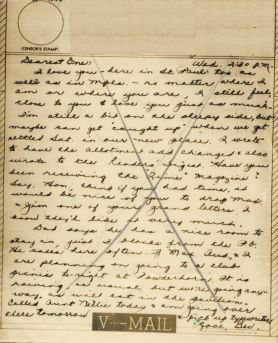
June 2, ’43
Wed. 2:30 p.m.
Dearest One:
I love you – here in St. Paul too as well as in Mpls. – no matter where I am or where you are, I still feel close to you & love you just as much.
I’m still a bit on the sleepy side, but maybe can get “caught up” when we get settled Sat. in our new place. I wrote to have the allotment add. changed & also wrote to the Readers’ Digest. Have you been receiving the “Time” magazine? Say, Hon., think if you had time, it would be nice of you to drop Max. & Jim one of your grand letters. I know they’d like it very much.
Dad says he has a nice room to stay in, just 3 blocks from the P.O. He calls here often.
Max., Aud., & I are planning on going to a Club picnic to-night at Powderhorn. It is raining, as usual, but we’re going anyway, as will eat in the pavilion. Called Aunt Nellie today & am going over there tomorrow & pick up typewriter.
Love,
Bev
Tags: Bev & Ande
[Written to Alice in Frankfort, Indiana. Return addressed to Richard, Plt. 622, R.D.M.C.B., San Diego 41, Calif. Postmarked in San Diego, Calif., on 1 June 1944 at 8 PM.]
6/1/44
Pvt. Richard
Plt. 622 R.D.M.C.B.
San Diego 41, Calif.
Hi Sweetheart,
Well, there is the address. I’m afraid I won’t be able to send it air mail though. I can’t get out and get any stamps. Too busy.
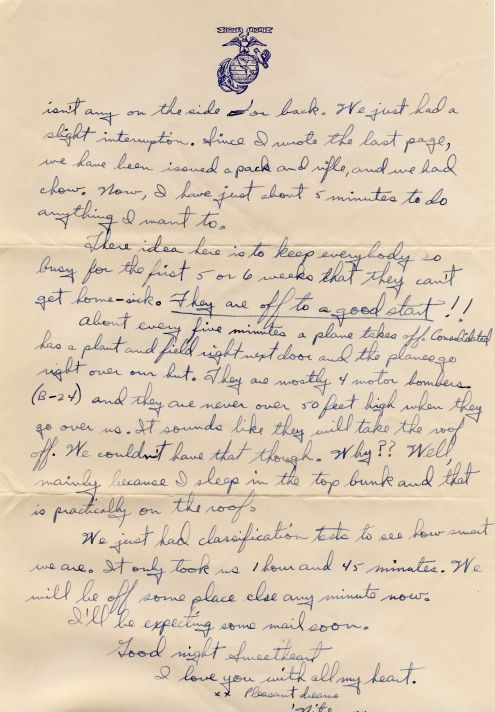
We got here at the base at 11:15 Tuesday night. We finally got no to bed at 2 A.M. They have had us running every since we got here. I hope I’ll be able to finish this. We got most of our uniform yesterday and we are sleeping in a hut with wall-board sides and a tin roof. There are 21 of us in this hut. We get up at 5:30 & go to bed at 10:00. Since I’ve been here, I’ve had a total of 10½ hours sleep. Not bad for 2 days & nights, huh?? We had our physicals yesterday. (1 blood test, 2 shots, & 1 vaccination.) Today we saw a short movie and got a haircut. After about 20 of the 63 guys in the platoon had theirs cut and we had had mess, cleaned up the hut, and seen the movie, they raised the colors. (They raise the colors at 8:00 A.M.) If you see any hair on this letter, think nothing of it. Just call me baldy. My hair is about ½ inch long on top and there just isn’t any on the side of or back. We just had a slight interruption. Since I wrote the last page, we have been issued a pack and rifle, and we had chow. Now, I have just about 5 minutes to do anything I want to.
There [sic] idea here is to keep everybody so busy for the first 5 or 6 weeks that they can’t get home-sick. They are off to a good start!!
About every five minutes a plane takes off. Consolidated has a plant and field right next door and the planes go right over our hut. They are mostly 4 motor bombers (B-24) and they are never over 50 feet high when they go over us. It sounds like they will take the roof off. We couldn’t have that though. Why?? Well, mainly because I sleep in the top bunk and that is practically on the roof.
We just had classification tests to see how smart we are. It only took us 1 hour and 45 minutes. We will be off some place else any minute now.
I’ll be expecting some mail soon.
Good night Sweetheart
I love you with all my heart.
x x Pleasant dreams
‘Nite x x
Tags: history · Richard & Alice
Today marks the 189th anniversary of the birth of Walt Whitman. Raised as a Quaker, and spending nearly 73 years on earth, he worked as a schoolteacher, newspaper editor, an office clerk and a Civil War nurse. In 1855, he self-published Leaves of Grass, a long-form poem whose beauty and eloquence have, over time, obscured his otherwise mundane everyman existence.
Happy birthday, Walt Whitman.
A child said, What is the grass? fetching it to me with full hands;
How could I answer the child?……I do not know what it is any more than he.
I guess it must be the flag of my disposition, out of hopeful green stuff woven.
Or I guess it is the handkerchief of the Lord,
A scented gift and remembrancer designedly dropped,
Bearing the owner’s name someway in the corners, that we may see and remark, and say Whose?
Or I guess the grass is itself a child….the produced babe of the vegetation.
Or I guess it is a uniform hieroglyphic,
And it means, Sprouting alike in broad zones and narrow zones,
Growing among black folks as among white,
Kanuck, Tuckahoe, Congressman, Cuff, I give them the same, I receive them the same.
And now it seems to me the beautiful uncut hair of graves.
Tenderly will I use you curling grass,
It may be you transpire from the breasts of young men,
It may be if I had known them I would have loved them;
It may be you are from old people and from women, and from offspring taken soon out of their mothers’ laps,
And here you are the mothers’ laps.
This grass is very dark to be from the white heads of old mothers,
Darker than the colorless beards of old men,
Dark to come from under the faint red roofs of mouths.
O I perceive after all so many uttering tongues!
And I perceive they do not come from the roofs of mouths for nothing.
I wish I could translate the hints about the dead young men and women,
And the hints about old men and mothers, and the offspring taken soon out of their laps.
What do you think has become of the young and old men?
And what do you think has become of the women and children?
They are alive and well somewhere;
The smallest sprout shows there is really no death,
And if ever there was it led forward life, and does not wait at the end to arrest it,
And ceased the moment life appeared.
All goes onward and outward….and nothing collapses,
And to die is different from what any one supposed, and luckier.
– Section 6, from Leaves of Grass [Song of Myself], by Walt Whitman
Tags: books · language
Last Sunday’s New York Times travel section featured a little story about what some consider a growing vacation trend: open-water swimming trips. I’ve been thinking about the article all week.
The story’s author, Bonnie Tsui, chose to focus on four very different travel companies and the experiences they provide. Swim Art, for instance, leads swimmers to both salt-water (the San Francisco Bay around Alcatraz) and fresh-water (Lake Tahoe) locales in northern California, and the London-based SwimTrek offers a two-day swimming expedition down the Thames River that incorporates frequent rest stops at riverside pubs (for local color, I suppose, and “re-fueling”). Tsui describes similar trips to Mexico, Chile, the Greek Islands, and a swimming tour of the British Virgin Islands aboard a 65-foot trimaran yacht.
Those really do sound like my idea of a vacation: getting away from it all to a fresh, unfamiliar place that provides a new perspective and the chance to reinvigorate both body and mind. They are currently, and sadly, a bit out of my financial and physical reach. But I got to thinking about my experiences with the open-water swim, and the opportunities for that that might exist for me now, on a smaller scale.

Aside from regular trips to the beaches around Oceanside, California, during my youth, my first official open-water swim was the La Jolla Rough Water Swim. This was in the 1970s. The event is still held – now in its 78th year – with around 2,000 swimmers dashing into the Pacific Ocean from the sands within the beautiful La Jolla cove. The year I participated, our entire family went. I swam the junior course – the short course for kids – while my sister Tricia swam the long route. Even from the vantage point atop the rocks of the cove, the long course swimmers were reduced to specks on the water’s horizon, until they reached their buoy goal and began re-emerging into view as they raced back to the beach. For my part, I remember tripping over a low wave as I dashed out of the water. Another kid passed me on the way to the finish line and tripped, himself, on the sand, allowing me to regain both my position and the bit of composure I had lost at the water’s edge.

In the mid-1980s, I took frequent weekend bike trips from Cambridge out the Mass. Ave. battle road to Concord and Lexington. It was a great route to ride, flat terrain most of the way, and the Boston drivers – accustomed as they were to bikers on the road – treated you with respect. One of my favorite end-point destinations was Walden Pond. I’m not sure what the situation is like now, but in those days, you could ride on asphalt or cement roads right up to the edge of the Walden Pond property and walk your bike along the wooded paths to a secluded spot near the northwest edge of the water, not far from the inlet known as Thoreau’s Cove. This would take you right past the site of Henry David Thoreau’s cabin, where visitors were encouraged to drop a stone to commemorate the building. At water’s edge, I would tie my bike to a tree, change into swim trunks and wade into the green waters of the lake – it really is much bigger than any pond I’ve ever seen – then swim to the opposite shore. No motorboats, ski-doos, or patrol boats to run you down or break the peaceful sound of lapping water, birds, or tree branches rustling in the breeze. Maybe an occasional person or duo in a canoe or rowboat would drift by, with a wave and a “hello,” obviously with the same urban-escapist intentions as mine. On the far side of the Pond, with bare feet, I had to step carefully among the rocks and growth along the bank, and had at least one nasty confrontation with a colony of Thoreau’s ants:
One day when I went out to my wood-pile, or rather my pile of stumps, I observed two large ants, the one red, the other much larger, nearly half an inch long, and black, fiercely contending with one another. Having once got hold they never let go, but struggled and wrestled and rolled on the chips incessantly. Looking farther, I was surprised to find that the chips were covered with such combatants, that it was not a duellum, but a bellum, a war between two races of ants, the red always pitted against the black, and frequently two red ones to one black. The legions of these Myrmidons covered all the hills and vales in my wood-yard, and the ground was already strewn with the dead and dying, both red and black. It was the only battle which I have ever witnessed, the only battle-field I ever trod while the battle was raging; internecine war; the red republicans on the one hand, and the black imperialists on the other. On every side they were engaged in deadly combat, yet without any noise that I could hear, and human soldiers never fought so resolutely. I watched a couple that were fast locked in each other’s embraces, in a little sunny valley amid the chips, now at noonday prepared to fight till the sun went down, or life went out. The smaller red champion had fastened himself like a vice to his adversary’s front, and through all the tumblings on that field never for an instant ceased to gnaw at one of his feelers near the root, having already caused the other to go by the board; while the stronger black one dashed him from side to side, and, as I saw on looking nearer, had already divested him of several of his members. They fought with more pertinacity than bulldogs. Neither manifested the least disposition to retreat. It was evident that their battle-cry was “Conquer or die.”
Aside from that encounter, I will testify that a swim in Walden Pond is better than any half-hour spent soaking in the bathtub and, on those leisurely weekend days, it was a terrific energizer for the ride home.
For nine years, I lived so close to the Charles River, which provided me with a great biking route. It is unfortunate that the River wasn’t – and isn’t – also swim-friendly, but if you know that old Standells song “Dirty Water,” or if you have gotten close enough to stick your toe in it, you know why that is.
[audio:Standells___Dirty_Water.mp3]
Sometime during my first year in Birmingham, I participated in an open-water swim at Oak Mountain State Park, just south of the city. It has been odd living far from an ocean these past 20 years, but thankfully we have lakes (Oak Mountain’s lake would be considered a pond in New England!). I remember little about that open-water swim, though I know it was a half-mile swim, as that is what my t-shirt prize says, and that it was coordinated by the local YMCA. I haven’t swum in open water since then. That was 1988.
I am writing all of this down, in part, as a reminder memo to myself to ask someone at the Y if there is still an open-water swim at Oak Mountain or anywhere else in the area. It’s summer, it’s the best season for outdoor swimming, and if there’s any activity that is well-suited to preparing oneself for an eventual swimming vacation off the rocky shoreline of Crete, it is more outdoor swimming.
Tags: health · self
I apparently am much too liberal with my YouTube “favorite” button. After clearing out several videos that were really good once, I was left with ten really interesting clips. Here are three of them:
This is Rey Villalobos, from the California band The Coral Sea, playing an acoustic version of a new song called “There She Goes.” The band’s 2005 album, Volcano and Heart, was and still is one of my favorite records. It is easy to imagine the lush soundscape that runs through Volcano having its way with this tune. It’s very lovely.
About once a year, Levon Helm pops up unexpectedly in a movie I’m watching. He is usually on-screen for five minutes or less, but in Shooter and The Three Burials of Melquiades Estrada – from which this clip is taken – he provides what is arguably the highlight of the film. His blind, lonely old man, begging the travelers to take him out of his misery, is a simple, eloquent character. My heart went out to him.
My friend Clinton sent me this clip via Facebook. I had to watch it a couple of times to convince myself that it wasn’t fake, though it looks like there was some fast and loose play with speed toward the end of the clip. But that matters little. This guy is in amazing shape! I especially marvelled at the wall running bits.
Tags: film · music
• One of my many peculiarities is my disdain of the popular overuse of the word “thing.” I would call it a pet peeve, ranking near the top of my list with turn-signal non-usage and the misuse of and over-reliance on cellular telephones. Why, when the English language is so rich with word choices both complex and simple, would any self-respecting educated person expose his laziness to the world by substituting “thing” for any of the wide variety of expressions at his disposal? “Doohickey” and “thingamajig” get a pass from me, as their use in spoken language reveals some humor and implies that the speaker knows that there is another, more appropriate, word for that moment that they momentarily cannot access.
I suppose I could go on about this, but it gets really tiresome. For both of us.
• Why do people mutter under their breath? Do they really not want you to hear what they are saying? I don’t think so. Usually, when people are said to “mutter under their breath,” they are speaking in a low, quiet tone. As described, muttering under the breath would be less audible than breathing which, in most cases, would be about as loud as silence. If the mutterance were not meant to be heard, I imagine that the mutterer would merely think it. Thus, muttering under the breath is more of a dramatic parry. Here, catch this, if your senses are sharp enough, seems to be the message. It’s a gamble on the part of the mutterer that he can get away with saying something that in text would be written parenthetically, and is most often an insult, offensive, or a rhetorical challenge. I do it more often than I would care to admit.
• Why are we fascinated by sadness? (I am assuming here, possibly falsely, that “we” share the fascination that “I” possess. He said, muttering under his breath.) Last night, doing a little channel-surfing, I happened upon Million Dollar Baby, the Clint Eastwood film. It’s a wonderful film, strong on character and story, and as tragic and heart-wrenching as a Shakespearean drama. I ended up watching it for about half of an hour. I just could not turn away. I thought about how much I enjoy Eastwood’s movies, especially those from this later part of his career that he has directed and, presumably, chosen to work on. Unforgiven and Mystic River, specifically, contain the same thread of melancholy that I responded to in Million Dollar Baby. And I could watch Unforgiven over and over again. Puzzling. Hey, I just realized that Clint and I have something in common. Maybe I should give him a call.
The same is true of sad songs. Songs about sunshine and dancing and blissful love are fine, and I like The Beach Boys a lot. But it’s “The Warmth of the Sun,” “Caroline, No” and “I Just Wasn’t Made for These Times” that end up looping around in my head for hours. What’s up with that?
• My next-door neighbors began sharing their daily newspaper with me recently. My end of the bargain is to make sure that the papers get recycled on Wednesdays, which is easy enough. This news exchange has provided a base for conversation starters between us which, most of the time, revolve around the circus that is Birmingham’s city government. And, if you live here, you know what that means: lots of talk of Larry Langford!
I’ve been thinking of things that Mayor Langford could start doing to (a) improve his image, (b) improve his and his staff’s effectiveness, (c) help the city economy, and (d) loosen the knots in my intestines that appear every time I hear his name mentioned. They are:
- Start using his full name. Lawrence Langford has a more elevated sound to it. If it fails to earn a smidgen more respect from the citizens, its use would at least be more fitting to someone self-compared to the King of Ninevah. King Larry versus King Lawrence. See what I mean? It worked for Debbie Gibson. But maybe his given name is indeed Larry, in which case, kinghood is definitely out of the question. Do not, under any circumstances, allow people to refer to him by his initials LPL, as it may cause some people to confuse him with lipoprotein lipase, an enzyme that hydrolyzes lipids in lipoproteins, like those found in chylomicrons and very low-density lipoproteins, into three free fatty acids and one glycerol molecule. (I’m just sayin’.)
- Turn self-righteousness into group-righteousness. Tell someone, anyone, that he or she is correct. Do this at least once every hour – spread it around a little bit – and make sure there is a media person within earshot to record it.
- Enough with the God platform. Get off of it. We know that he has God within him because GOD IS EVERYWHERE! (Mutterance: Catechism class, day one.) The new rules dictate that each time Langford mentions His name while on the job, he must put $1,000 into a neighborhood fund to be split between Roderick Royal’s and Valerie Abbott’s city districts. That’ll put the kibosh on that in a flash. (Mutterance: Or, start saying the word “thing” instead of God, Jesus or Jehovah. That’ll really get people thinking.)
- Demand that his chief of staff Deborah Vance stop wasting time at work Googling her name. At least once a week, I get a hit from someone Googling “deborah vance” and linking to a February 19th post on my blog. If she spent less time doing this, she’d have more time to spend effectively deflecting media attention from his latest gaffe. And, if the phantom Googler is not Ms. Vance, at least she is now aware that someone out there is researching her on a regular basis.
- Write a blog on al.com. Allow comments.
- Learn the difference between constituency (all: a fairly constant number) and voting block (some: a highly variable number). Learn where the entirety of the constituency lives. Put that Harvard Public Policy seminar – the one that is mentioned in his Wikipedia entry, but has a footnote that doesn’t even contain the reference – to work.
- Stop smoking. He’ll save money at the dentist. And we might have saved money on a smoking patio.
Tags: film · ideas · language · music · politics · self


