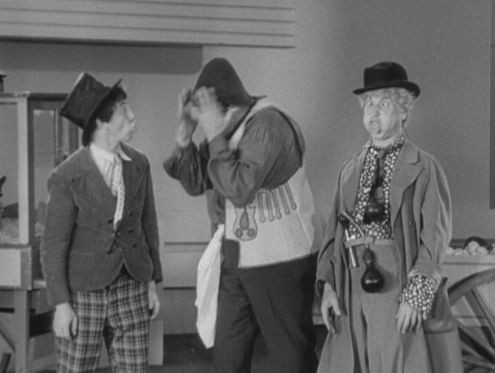
Relative to the brief discussion on this post, regarding Harpo Marx’s facial expression (which I called the “inflatable elephant face”), here’s the tale of the origin of the Gookie – in Harpo’s own words – from Harpo Speaks:
The man who first inspired me to become an actor was a guy called Gookie. Gookie had nothing to do with the theatre. He rolled cigars in the window of a cigar store on Lexington Avenue.
This was the store with card games and bookmaking in the back room, the nearest thing to a social club in our neighborhood. It was Frenchie’s home away from home and, along with the poolroom, Chico’s too. Since gambling was never the obsession with me that it was with Chico, I didn’t spend much time in the back room. Where I had the most fun was on the street, in front of the store.
Gookie worked at a low table, facing the Avenue through the window. He was a lumpy little man with a complexion like the leaves he used for cigar wrappers, as if he’d turned that color from overexposure to tobacco. He always wore a dirty, striped shirt without a collar, and leather cuffs and elastic armbands. Whether he was at his table in the window or running errands for the cardplayers, Gookie was forever grunting and muttering to himself. He never smiled.
Gookie was funny enough to look at when he wasn’t working, but when he got up to full speed rolling cigars he was something to see. It was a marvel how fast his stubby fingers could move. And when he got going good he was completely lost in his work, so absorbed that he had no idea what a comic face he was making. His tongue lolled out in a fat roll, his cheeks puffed out, and his eyes popped out and crossed themselves.
I used to stand there and practice imitating Gookie’s look for fifteen, twenty minutes at a time, using the window glass as a mirror. He was too hypnotized by his own work to notice me. Then one day I decided I had him down perfect – tongue, cheeks, eyes, the whole bit.
I approached this documentary with some hesitation. After all, who would willingly settle, with any enthusiasm, into a screening of a film about suicide? The few reviews I had read about the film were positive, so I watched it, hoping to learn something new.
The film is beautiful. That is to say, the footage and photography are beautiful. The camera crew kept a vigil at the site of California’s Golden Gate Bridge for an entire year, so the comings and goings of the seasons – such as they are in northern California – are completely documented here. The setting of the span as it crosses the San Francisco bay into Marin is idyllic, and the filmmaker, Eric Steel, has captured the natural surroundings of the area lovingly.
I can’t imagine the anguished mental process of a conscientious cameraman deciding whether or not to take the job of filming this project. On the plus side, there is the natural beauty of the workspace, the opportunity to capture those surroundings on film, a relaxed outdoor atmosphere. Negatively, there would be cold and wet days, and most often the job would involve working alone. But what of the objective goal, the aim to capture people leaping to death from the Golden Gate Bridge? This would throw me into a moral quandry. Would there be a telephone network in place to alert the bridge security? Do I stop filming to attempt to stop this person from jumping? When I believe that the person can’t be stopped, do I continue filming? What constructive purpose (other than that of being a voyeur) does this footage ultimately serve?
I won’t say that these questions were all necessarily answered to my complete satisfaction in the film. The Bridge, however, is not a sensationalistic work. While the focus is on the jumpers, and the footage of them attempting and, in some cases, accomplishing their premeditated goal is included, the bulk of the film is an eloquent and thoughtful meditation on suicide by those left behind. Steel sought out the family members and friends of the subjects, and recorded their emotional ruminations on troubled lives, and on their loss. Some express guilt and responsibility, and others seem to view suicide as a logical, though unfortunate, conclusion to their friend’s life.
I did not create this image, and could not find the photo/art credit, but did not stumble upon it by accident. Brentski planted a vague mental image in my head when he described a national politician’s upper appendages as ‘chicken arms,’ so I went on the hunt for a representative photograph. This one seemed to fulfill my mental image quite nicely. In the future, however, I am going to be checking the chicken at the supermarket for any similar terry-cloth finish, which does not look particularly appetizing.
I try to acquire some useful knowledge as often as I can, and this week I learned a new trick.
I’ve been visiting The Criterion Contraption lately, reading Matthew Dessem’s lengthy reviews of Criterion Collection DVDs, as he views them in the chronological order of their release. His lively text is accompanied by still captures from the films, and the still shots are impeccably chosen, always illustrating a point in the writing. I’ve tried to capture stills from DVDs, too, but have had no luck using my own vast ingenuity. (Vast, I tell you!) Anyway, I spent a couple of hours traversing the internets, and found some information that allowed me to capture stills without downloading any new software. Shhh, here’s the secret…right here.
So, I thought I’d play a game that combines my newly-found techie talent with my love of lists. Here are five of my favorite facial expressions that I’ve seen in the movies:
1. Harpo Marx in Duck Soup (1933).
This has always been a favorite facial expression of mine, one that I once was able to mimic. I call it the “inflatable elephant face.” These days all I have to do is cross my eyes and I’m already rounding third. Harpo used this bizarre facial morph to disarm people. Here he’s disarming Edgar Kennedy, with an able assist from Chico (who does the inflatable elephant quite well, too). I believe that Harpo makes this face in every Marx Brothers feature at least once.
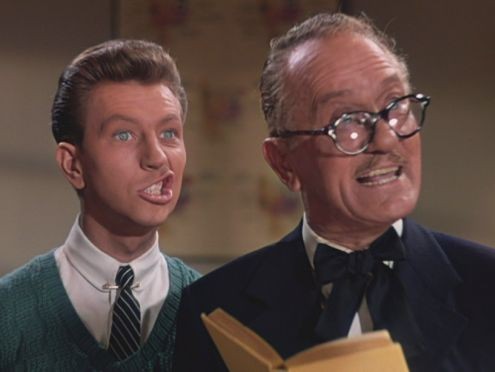
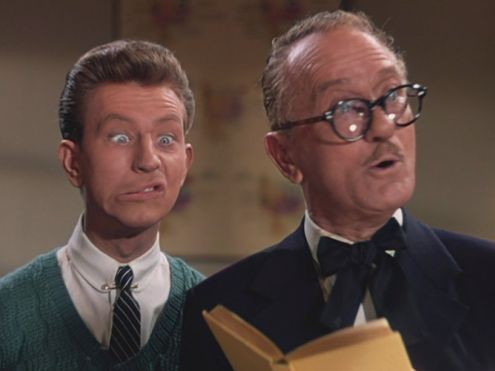
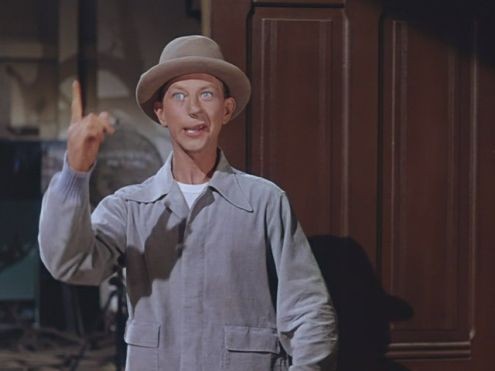
2. Donald O’Connor in Singin’ in the Rain (1952).
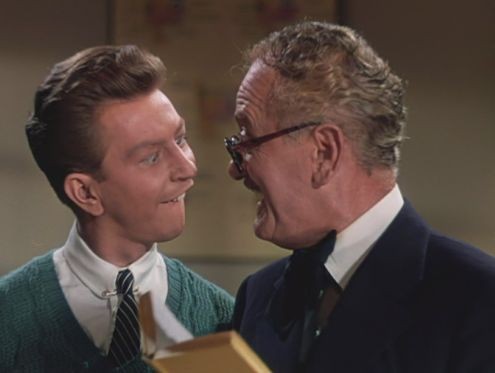
This series of faces is not too far removed from Harpo’s inflatable elephant face. It is from the “Moses Supposes” musical number, in which O’Connor and Gene Kelly are learning the finer points of English diction to ease the transition from silent pictures to talkies. I love the subvervise nature of these. O’Connor is mimicking the diction coach’s face as he pronounces the lesson, and stops making the face whenever the coach turns toward him.
As you can see, the diction coach comes face to face with O’Connor’s antics in the end.
Running a close second to the Moses face is this disfiguring mug from the same movie. It is from O’Connor’s “Make ‘Em Laugh” number, and displays his facial wreckage after he slams himself face-first into a brick wall. It looks like a special effect, as if the prop man had tied fishing line to the end of his nose and was tugging at it from off-camera. But I have read that it is a true Donald O’Connor facial expression.
3. Dorothy Comingore in Citizen Kane (1941).
SUSAN: You’re awful funny, aren’t you? But I can tell you one thing you’re not gonna keep on being funny about. That’s my singing. I’m through. I’ve never wanted to in the first place.
KANE:
You will continue with your singing, Susan. I don’t propose to have myself made ridiculous.
SUSAN:
You don’t propose to have yourself made ridiculous. What about me? I’m the one who’s gotta do the singing. I’m the one who gets the raspberries. Why don’t you let me alone?
KANE:
My reasons satisfy me, Susan! You seem unable to understand them. I will not tell them to you again. You will continue with your singing.
Susan Alexander Kane is a pitiable character, but also just plain annoying. Infuriatingly so. With her whining, hyper-shrill screaming voice, and constant yack yack yack, it is easy to see why Charles Foster Kane was driven nuts by her. But he also saw her as someone he could control and possess, and by the end of this scene, Susan is defeated by his authority (visually represented by his towering shadow). This was the closest she ever came to winning a battle with Kane, until she learned that the best offense was just to leave. I love her curled lip when she is screaming at him; it’s way over-the-top, but effective as hell, and you can practically feel her hatred.
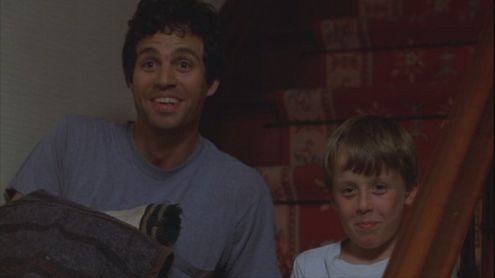
4. Mark Ruffalo and Rory Culkin in You Can Count On Me (2000).
This one suffers a little when it is captured in a still frame, as Ruffalo’s and Culkin’s faces go through a series of spasms as they try to speak seriously without breaking into excitable laughter. They have just been caught sneaking into the house late at night by Culkin’s mother (and Ruffalo’s sister), played by Laura Linney. While on-the-spot improvising a series of completely implausible excuses to explain why the boy is still awake so late at night, the uncle and nephew keep looking at each other and cracking each other up. This was one of the more light-hearted moments in a very serious and emotional drama (and one of my absolute favorite movies).
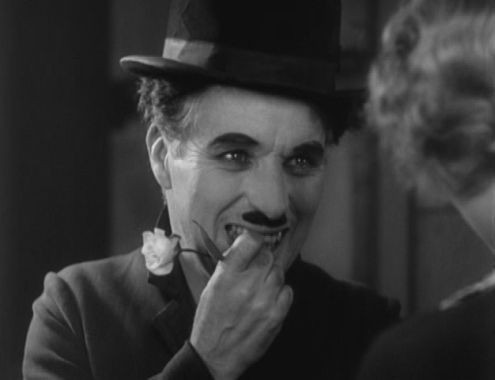
5. Charlie Chaplin in City Lights (1931)
and Woody Allen in Manhattan (1979).
That shot of Chaplin is a cinema classic, of course, and is the last shot of the film. City Lights ends completely open-ended, with the possibility of a happily-ever-after future almost as palpable in the viewer’s mind as it apparently is in Chaplin’s.
I don’t know this for certain, but my feeling has always been that Woody Allen borrowed inspiration from that scene in City Lights for his closing scene in Manhattan. Note the love interest in the right foreground, and the street behind him while he faces the camera.
Woody’s character is hoping – against reasonable odds – for a happily romantic future with the 18-year-old Mariel Hemingway character. Knowing what happens six months after this scene is unnecessary. It is enough to know that the Chaplin and Woody characters are able to hold out hope for a better future than the present that they currently inhabit. And you can read that in the expression on their faces.
I know, I know. The last nine out of ten posts on this site have had something or other to do with politics. If you have read closely, you’d have noticed that I’ve even mentioned how weary of politics I am growing (it’s buried in there somewhere). Yet, post after post, I reference the current political dance, which I am obviously fascinated by. Believe me, if I felt at all adept at economics beyond my own checkbook, I would be posting some horrific sludge about the stock market crash of 2008 or the credit crisis. As it is, I have frequent thoughts about the ominously disastrous trends in the retail sector, my old stomping grounds. But I avoid those things that I feel are better explained by other people.
I received an e-mail recently from a daily reader of this blog. In it, the reader complained of this infusion of political content. The reader’s note referred to it as a “disgusting trend.” And, though the phrase was meant to refer to the general relentless buzz in the media about all things political, I personalized it. And I do not necessarily disagree. But, somehow, writing a paragraph or two right now describing my opinion about a new Renee Fleming CD (which I am listening to) or the progress of my roof replacement (which is happening rightnow) seems frivolous.
On the other hand (and there seem to be more than two hands here), perhaps frivolous is needed. This other stuff – while fascinating – is just so serious.
All of this finger-pointing and fear-mongering is driving me nuts. When I leave the TV and radio turned off, I do not get driven nuts. A+B=C? Uh-huh. But this hyper-charged political season has less than a month to go, I keep telling myself, so I continue to pay attention. Someone will win and all of this nastiness will end. LOL.
Now we are asked to believe that Barack Obama is in some way allied with 1960s anti-war activist William “Bill” Ayers. The accusation from John McCain’s campaign seems outrageous and desperate, but it is probably having its effect where an effect was intended. Sure, Obama was only a kid when Ayers was practicing his craft as an “American terrorist” (Sarah Palin’s words). The issue of guilt by association arises from the span between 2000 and 2002 when Obama and Ayers both sat on the board of the Woods Fund of Chicago, a community anti-poverty group, and from the fact that Ayers hosted a social at his home to support Obama’s run the Illinois state senate, and that Ayers contributed $200 to Obama’s re-election campaign for that state senate seat in 2001. About the last association, common sense should tell one that a former radical would want to take a stand and, in the absence of a Terrorist Party candidate, Ayers chose one with an open mind (traditionally, a Democrat and, in this case, Barack Obama).
And about the Woods Fund board. If you have ever sat on the board of any organization, you are aware that board members come and go, and many of the members meet each other – in the context of that group – for the very first time. We know that Ayers and Obama had met prior to being on this board, but we could easily assume that they were drawn to it because of the organization’s community goals, not because of their mutual attraction to each other’s anti-establishment ideals. I once sat on a board that included among its members one Richard Scrushy. Does this make me a perpetrator of corporate fraud or a millionaire? No to #1 and no (sadly) to #2.
The accusations are, obviously, speculatory. But they raise more questions than answers. Obama has denied his ties to Ayers, but the circuit of denial and explanation is incomplete. My question is this: where is Bill Ayers?
I keep expecting him to show up on 60 Minutes or on CNN to set the story straight. I suppose that Obama wouldn’t want him to appear next to him on the campaign trail to discuss this issue (more guilt by association would ensue), but some statement from Ayers could nip this noise in the bud. Remember that scene from Annie Hall, when Woody Allen pulls Marshall McLuhan from outside the movie screen to settle a debate about his theories? That’s what I’d like to see. Something like that.
If life were only like this, indeed.
Even Ayers’ blog has been mysteriously silent for the last month or so. If I lived in Ayers’ neighborhood of Hyde Park, I would drop by for a visit and ask him to step up to the plate. I am surprised that a nation full of generally curious (and usually loud) journalists haven’t made contact with him and reported on their exchange. Has he refused contact with the media? Can no one spare us the endless onslaught of self-righteous accusations?